


Quick Answers
- Did Dune inspire Star Wars? Very likely, yes—at least in a broad creative sense.
- The heart of the Dune vs. Star Wars inspiration debate is not copying, but transformation.
- The strongest case for Frank Herbert's influence on Star Wars lies in shared elements such as desert worlds, prophecy, Empire, sacred orders, and spiritual power.
- Dune is more political, ecological, and suspicious of savior figures, while Star Wars is more mythic, emotional, and hopeful.
- The fairest conclusion is that Dune helped shape the imaginative landscape of epic science fiction, and Star Wars turned part of that landscape into cinematic legend.
Proof & Sources
To understand this comparison more clearly, it helps to look at reliable background references on both universes. These sources offer useful context for how Dune and Star Wars sit in science-fiction history and why the comparison continues to resonate with fans.
Have you ever watched Star Wars and suddenly felt that Tatooine, prophecy, Empire, and even spice all seemed strangely familiar—especially if you had already encountered Dune?
Why This Debate Feels So Familiar
That feeling is exactly why so many fans keep asking whether Dune inspired Star Wars. The comparison feels immediate because the echoes are easy to notice, yet the answer never becomes completely simple once you look closer. Frank Herbert's Dune arrived in 1965 and reshaped what science fiction could be, proving that the genre could feel ancient, spiritual, political, and intensely layered without losing its epic scale. When Star Wars appeared in 1977, audiences met another universe shaped by desert hardship, imperial conflict, mystical power, and a hero drawn toward destiny. It is no surprise that people still return to the question: Did Dune inspire Star Wars?
Still, the answer cannot be reduced to a casual comment about sand, prophecy, or a shared interest in Empire. George Lucas did not build Star Wars from a single source. He drew from mythology, Japanese cinema, pulp serials, westerns, war films, and fairy-tale storytelling. Yet Herbert's influence on modern speculative fiction was already so large that it is difficult to imagine later space epics developing in total isolation from it. That is why the Dune vs. Star Wars inspiration debate continues to matter. It is really a conversation about how major stories inherit ideas, reshape them, and turn them into something new.
The Shared Language of Desert, Empire, and Destiny
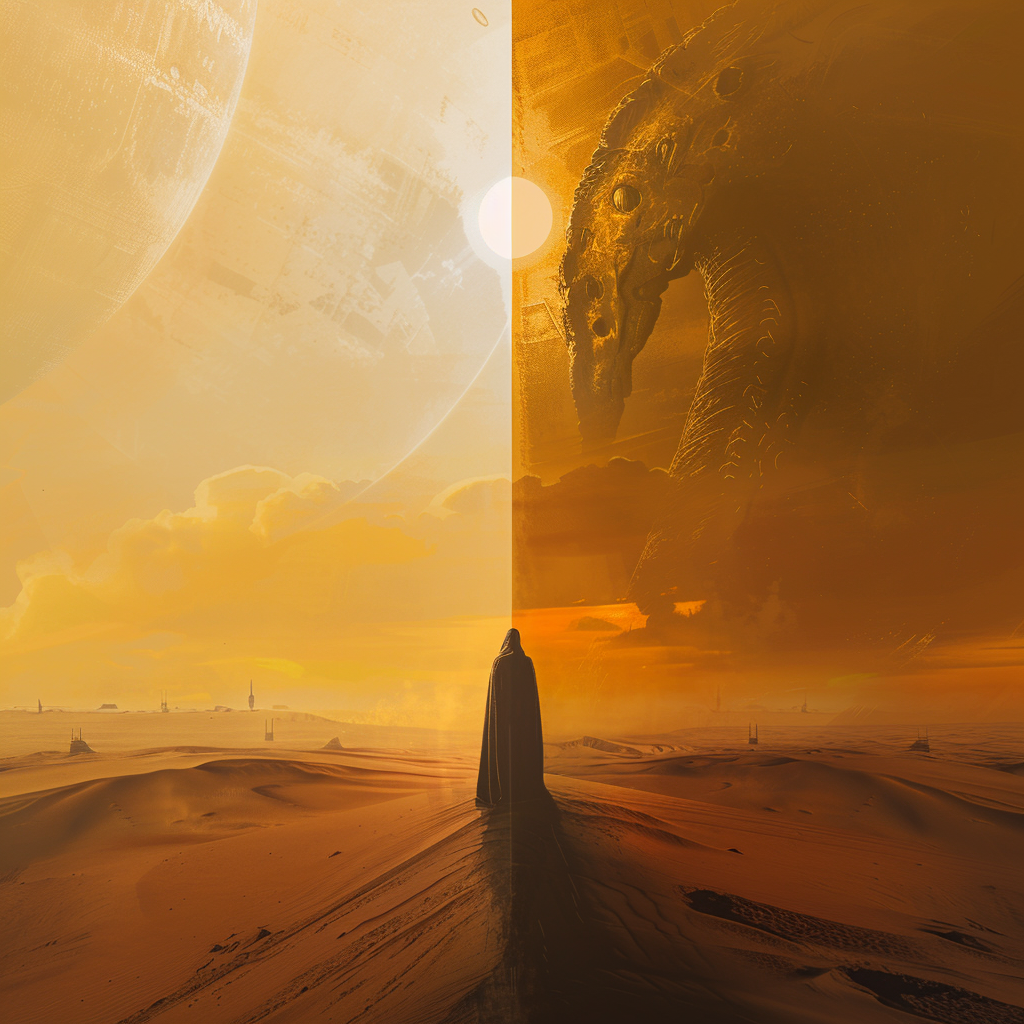
The first connection most readers notice is the desert. Arrakis in Dune is not just a location. It shapes religion, survival, economics, power, and identity. Tatooine in Star Wars functions differently, but it also carries enormous symbolic weight. It is harsh, remote, and old, a place where ordinary life feels small and destiny feels strangely near. In both stories, the desert becomes the ground on which the hero begins in a limited role and slowly moves toward a larger role. That is one reason the question "Did Dune inspire Star Wars?" feels so natural to ask.
Then there is spice, perhaps the single most famous overlap in any discussion of **Frank Herbert's influence on Star Wars. In Dune, spice is essential to the structure of civilization. It touches prophecy, trade, interstellar travel, political power, and spiritual transformation. In Star Wars, spice appears in lore as a dangerous or illicit substance, but it does not carry the same universe-defining importance. The resemblance is real, but the function is not identical. That difference matters because it shows how influence often works in creative storytelling. A later work may echo an idea without adopting its entire meaning.
The political scale also feels related. Dune is filled with imperial control, noble houses, resource struggle, and long strategic calculation. Star Wars also frames personal lives within a galaxy-wide conflict shaped by the Empire, the rebellion, and an inherited legacy. In both worlds, private identity is never fully private. The hero is drawn into systems far larger than individual desire. This gives both sagas a sense of historical weight, even though one is more philosophical and the other more cinematic.
Ancient orders deepen the comparison. The Bene Gesserit in Dune and the Jedi in Star Wars are not equivalents, but both stand for disciplined traditions in which knowledge, spiritual practice, and historical consequence are intertwined. Both imply that power is not only technological or military. It can also come from training, control, inherited wisdom, and a relationship to something larger than the self. This shared imaginative terrain is one of the strongest reasons the Dune vs. Star Wars inspiration discussion remains persuasive.
Learn more: Dune 2 Is The Perfect Star Wars Prequel I Wish George Lucas Had Made 19 Years Ago
The Hero Means Something Different in Each Story
The biggest difference between Dune and Star Wars is not visual style or setting. It is the meaning of the hero. Dune is wary of the savior figure, while Star Wars still believes in one. That single contrast explains why two stories with so many surface similarities can feel so different at their core.
Paul Atreides is not presented as a simple triumphant chosen one. His rise is bound to manipulation, violence, religious expectation, and the dangerous momentum of history. Herbert does not allow messianic power to feel innocent. Even when Paul becomes awe-inspiring, the story keeps asking whether that greatness might become catastrophic. Dune does not merely give readers a heroic destiny. It interrogates the price of one.
Luke Skywalker stands inside a more traditional mythic structure. He is tested, tempted, and wounded, but his story still trusts courage, compassion, and redemption. Luke's importance does not function mainly as a warning against hero worship. Instead, Star Wars frames his journey as proof that moral choice can resist darkness. This is why the Dune vs. Star Wars inspiration debate becomes more interesting once it moves beyond visual comparison. Similar ingredients do not produce the same meaning. Herbert complicates destiny. Lucas renews it.
This difference also explains their emotional tone. Dune feels tense, intellectually compressed, and suspicious of charismatic power. Star Wars feels luminous, archetypal, and emotionally direct. One story wants the audience to think hard about the danger of epic leadership. The other wants the audience to believe that hope can still matter in a broken galaxy. That contrast does not weaken the case for Frank Herbert's influence on Star Wars. It strengthens it because it shows that influence can exist without imitation.
Ecology, Religion, and the Machinery of Power
Another key distinction lies in how each story treats the world itself. In Dune, ecology is central. Arrakis is not a dramatic backdrop but the heart of politics, culture, and survival. Herbert makes the environment inseparable from the Empire. Whoever misunderstands the desert misunderstands power. The planet is not passive scenery. It is a living force in the narrative's logic.
In Star Wars, planets often serve a more symbolic role. Tatooine represents hardship and origin. Dagobah represents a spiritual trial. Hoth means endurance. Mustafar feels like destruction made visible. Lucas uses words with great dramatic Force, but he does not explore them with Herbert's ecological intensity. This is why Dune often feels denser and heavier. It wants the reader to understand how environment, religion, and politics trap one another.
Religion creates a similar divide. In Dune, belief can be planted, shaped, inherited, and weaponized across generations. Herbert is deeply interested in how faith becomes power and how power manipulates faith. In Star Wars, the Force is more spiritually immediate. It can be misunderstood or corrupted, but it is not framed as a long-term political project of religious engineering. This difference is one of the clearest ways to understand the Dune vs. Star Wars inspiration conversation. Lucas may echo the grandeur of sacred power, but he does not treat belief with the same level of systemic suspicion as Herbert.
And yet, both stories share a concern with domination. Arrakis is exploited for what it produces, and the people of the desert live under structures of external control. Star Wars also portrays the Empire as an extractive, oppressive, and dehumanizing force. The difference is that Dune spends more time inside the machinery of those systems, while Star Wars translates them into cleaner mythic conflict. That is why the strongest argument for Frank Herbert's influence on Star Wars lies in atmosphere and narrative architecture rather than in direct plot borrowing.
Why Star Wars Became the More Universal Myth
If Dune is more layered in politics, ecology, and religion, why did Star Wars become the more universal cultural myth? The answer lies in emotional clarity. Lucas took epic material and made it instantly readable. Audiences do not need to understand imperial economics or environmental systems to feel Luke's fear, longing, loyalty, and transformation. Star Wars moves with the rhythm of legend, and that rhythm makes it widely accessible across generations.
That accessibility is not a weakness. It is one of Star Wars' great strengths. Lucas transformed large ideas into cinematic symbols that could live in film, television, games, toys, and collective memory. The farm boy, the dark father, the wise master, the rebellion, and the mystical energy field are all clear, powerful shapes. That is why asking whether Dune inspired Star Wars should never turn into an attempt to reduce Star Wars to a diluted version of Dune. Lucas was doing something different. He was taking some of the same epic possibilities and turning them into a more emotionally open form.
At the same time, Herbert had already shown that science fiction could be old, ceremonial, spiritual, and politically vast. Even if Lucas translated those possibilities into something faster and more mythic, Dune had already widened the imaginative horizon. This is the fairest way to read the Dune vs. Star Wars inspiration question. It is not mainly about copying. It is about inheritance and reinvention.
Read more: Star Wars Day 2026 Latest News: The Biggest Official Updates Before May the Fourth
So, Did Dune Inspire Star Wars?
The most balanced answer is yes, but not as a direct template. The similarities are too strong to dismiss as a meaningless coincidence. Desert worlds, sacred orders, Empire, lineage, prophecy, and the presence of spice all create a pattern that suggests genuine influence. At the same time, the differences are too deep to allow a simplistic conclusion. Dune is more suspicious of power, more focused on systems, and more willing to challenge the fantasy of the chosen hero. Star Wars is more mythic, more emotionally generous, and more committed to redemption.
That is why the strongest version of the Frank Herbert Star Wars influence argument is not that Lucas copied Herbert scene by scene. It is that Herbert helped define a richer kind of epic speculative storytelling, and Lucas then transformed part of that storytelling energy into cinematic myth. The relationship between the two works is not imitation. It is a creative transformation. That is precisely why comparing them remains so rewarding for fans. Dune sharpens our sense of how dangerous destiny can be, while Star Wars reminds us why epic stories still matter to people who need hope. 👉 Explore more lightsabers here.
So when someone asks, "Did Dune inspire Star Wars?" the strongest reply is simple: very likely yes, but mostly through atmosphere, scale, shared motifs, and imaginative inheritance rather than one-to-one copying. Herbert helped shape the field, and Lucas reshaped it for the screen.
FAQs
Did Dune directly inspire Star Wars?
In a broad creative sense, yes. But Star Wars also draws from many other influences, so the relationship is better described as inspiration than direct adaptation.
Why are Arrakis and Tatooine compared so often?
Because both are iconic desert worlds tied to hardship, identity, and destiny. They are not identical, but they serve similar symbolic roles in how each story introduces its hero.
Is spice in Star Wars the same as spice in Dune?
No. The term overlaps, but the narrative function is very different. In Dune, spice is central to civilization. In Star Wars, it plays a much smaller role.
Are Paul Atreides and Luke Skywalker the same kind of chosen one?
Not really. Paul is part of a warning about messianic power, while Luke belongs to a more hopeful mythic structure built around redemption and moral choice.
Is the Force similar to religion in Dune?
Only partly. Both stories involve spiritual power, but Dune focuses more on the political use of belief, while Star Wars treats the Force as a more direct moral and metaphysical reality.
Does the Bene Gesserit resemble the Jedi Order?
In terms of discipline and historical influence, yes. But their goals, methods, and ethical framing are very different.
Why does Dune feel more complex than Star Wars?
Herbert emphasizes ecology, imperial systems, religion, and unintended consequences much more heavily. Star Wars aims for mythic clarity and cinematic momentum rather than mythic clarity and cinematic momentum.
Why did Star Wars become more widely popular?
Lucas translated epic ideas into a faster, more emotional, and more accessible cinematic language that could reach a much broader audience.
What is the strongest argument for Frank Herbert's Star Wars influence?
The strongest argument is the overlap in atmosphere and worldbuilding: desert symbolism, Empire, prophecy, sacred orders, lineage, and the feeling of an ancient future.
What is the best final answer to "Did Dune inspire Star Wars?"
Yes, likely to some degree—but as influence, not imitation. Dune helped shape the imaginative landscape, and Star Wars transformed it into something original and cinematic.
Join the Nsabers Community
Bring the Force into your world with Nsabers.
✨ Follow Nsabers across the galaxy:
💬 We'd love to hear from you!
Share your thoughts by dropping a comment below or tagging us on social media.
May the Force be with you!


Leave a comment
All comments are moderated before being published.
This site is protected by hCaptcha and the hCaptcha Privacy Policy and Terms of Service apply.