

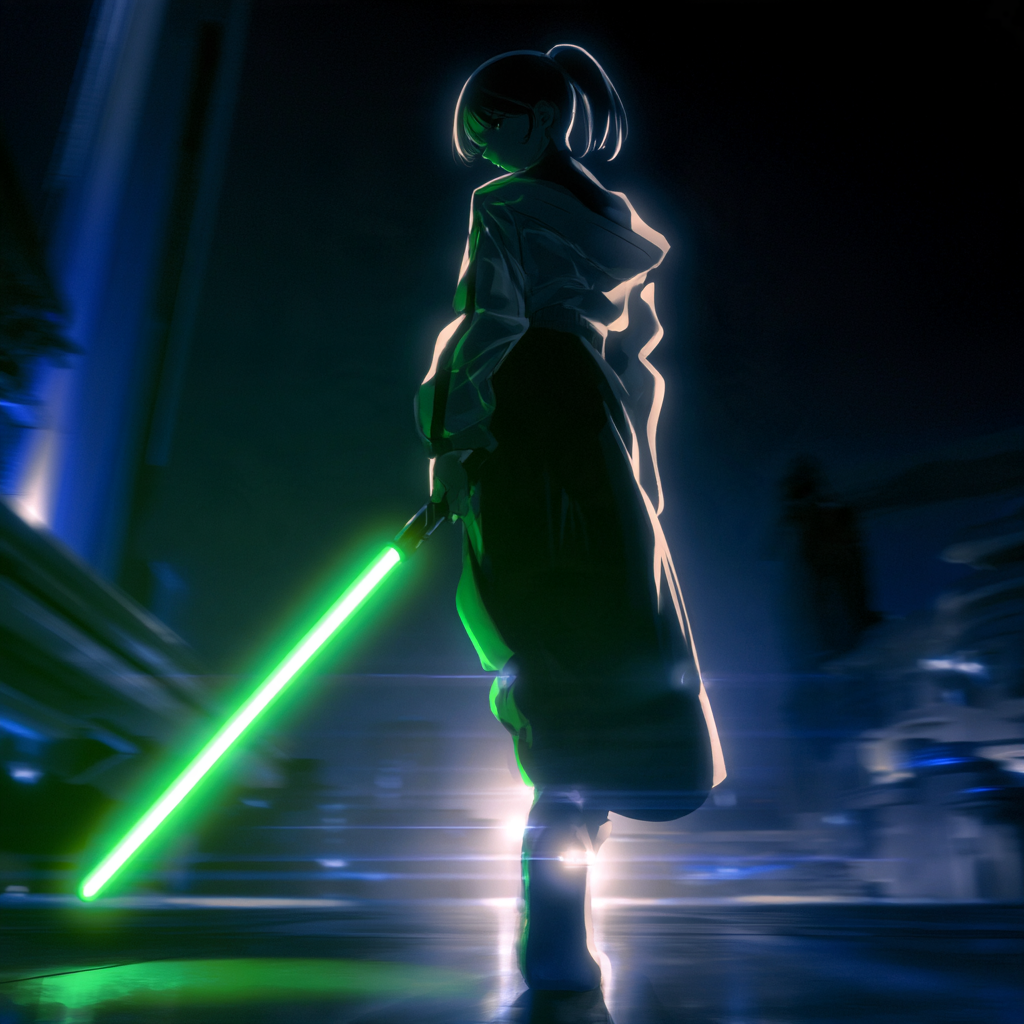
Quick Answers
- Star Wars: Visions Presents – The Ninth Jedi premiered on August 5, 2026, on Disney+ and Hulu.
- The new series is an 8-episode limited series created by Lucasfilm and Production I.G.
- The story continues the fan-favorite The Ninth Jedi short from Star Wars: Visions Volume 1 and The Ninth Jedi – Child of Hope from Volume 3.
- The story takes place far in the future, long after the fall of the Sith, when the Jedi Order has disappeared, and the galaxy is once again searching for hope.
- The central hero is Lah Kara, the daughter of sabersmith Lah Zhima.
- Other major characters include Margrave Juro, Ethan, Homen, General Nawaam, Gennoh, the Jedi Hunters, and several droids who accompany Kara on her journey.
- One of the most distinctive ideas in **The Ninth Jedi **is that specially tempered kyber crystals can change blade color according to the wielder’s connection to the Force.
- Kara’s initially colorless blade turns green; Homen’s blade changes from red to light purple. At the same time, General Nawaam surprisingly carries a bright blue blade despite seeking to destroy the Jedi.
Proof & Sources
The official Star Wars character guide confirms the August 5, 2026 premiere, eight-episode format, major characters, continuation from the original Visions shorts, and the series’ unusual lightsaber mythology.
- Star Wars: Visions Presents – The Ninth Jedi
- Watch on Disney+ and Hulu
- Star Wars: Visions Presents - The Ninth Jedi Character Guide
What happens to the idea of a Jedi when the Order has been gone for so long that even the color of a lightsaber can reveal whether its wielder truly belongs to the light or the dark?
The Ninth Jedi Release Date and Where to Watch
***Star Wars: ***Visions Presents – The Ninth Jedi premiered on August 5, 2026, exclusively on Disney+ and Hulu.
The series consists of eight episodes and expands a story that originally began inside the anthology format of Star Wars: Visions.
The original The Ninth Jedi short appeared in Visions Volume 1 and quickly became one of the anthology’s most discussed stories. Its combination of distant-future Star Wars mythology, mysterious Force users, a new generation of Jedi, and unusual lightsaber rules gave it the feeling of a much larger world waiting to be explored.
That story later continued in The Ninth Jedi – Child of Hope in Visions Volume 3.
The limited series now gives Kara’s journey substantially more room to develop.
Rather than functioning as another disconnected Visions short, The Star Wars: The Ninth Jedi series follows an ongoing cast, larger conflicts, and a galaxy where the Jedi Order itself has become something characters must rebuild rather than join.
The Story Takes Place Long After the Jedi and Sith We Know
The timeline is one of the key differences between The Ninth Jedi and most other Star Wars projects.
The story takes place in a distant future long after the fall of the Sith. The familiar Jedi Order is also gone, while war and political fragmentation continue across the galaxy.
That gives the series unusual freedom.
Characters don't operate under the Jedi Council seen in the prequels. They are not fighting directly inside the Galactic Civil War. And they don't have centuries of organized Jedi training to guide them.
Instead, Jedi identity has become fragmented.
Some Force users have no master.
Some former Jedi have abandoned their training.
Others are trying to rebuild the Order.
And some characters appear Jedi-like until the color of their blade exposes something much darker.
At the center of this unstable galaxy is Margrave Juro, a former Jedi Knight who wants to restore the Jedi Order.
His plan brings several Force users together—but it also attracts enemies who want the Jedi permanently erased.
***Read more: ***The Ninth Jedi: Star Wars' Future Timeline & New Jedi Order Explained
Lah Kara Is the Heart of The Ninth Jedi
The central protagonist is Lah Kara, a teenage girl from the frozen world of Hy Izlan.
She lives with her father, Lah Zhima, a sabersmith with deep knowledge of the Force and lightsaber construction.
Kara has been training in the Force from a young age and shows natural ability in lightsaber combat. But her biggest weakness is not physical skill. It is confidence.
She does not always trust her own abilities.
That becomes especially important after the Jedi Hunters capture her father.
Kara’s search for Zhima eventually brings her into Margrave Juro’s attempt to restore the Jedi Order. It puts her directly in the middle of a Sith ambush.
One of her defining moments comes when she initially holds a colorless lightsaber.
In her hands, the blade eventually becomes bright green.
The change is not simply cosmetic. It represents Kara’s strengthening connection to the Force and becomes one of the central ideas behind The Ninth Jedi lightsabers.
As Kara continues searching for her father, her power develops alongside her confidence.
That gives the series a classic Star Wars coming-of-age structure, but with a lightsaber mythology that makes her internal development physically visible.
Lah Zhima Changes How Lightsaber Colors Work
Kara’s father may be one of the most important figures in the series even when he is absent from the action.
Lah Zhima was once a Jedi Knight known for his combat ability. He later settled on Hy Izlan and became a sabersmith.
His most remarkable skill is his ability to temper kyber crystals so that they reflect the wielder’s connection to the Force.
That single concept changes the meaning of lightsaber colors inside this story.
Instead of a blade color functioning primarily as a fixed property of the weapon, the saber can reveal something about the person holding it.
Zhima builds eight lightsabers at Margrave Juro’s request.
Those weapons then become part of a dangerous test when multiple supposed Force users arrive at Juro’s Aerial Temple.
Some ignite blue or green.
Others reveal red.
The result transforms a familiar Star Wars object into a visual truth detector.
That is one reason the Star Wars The Ninth Jedi concept became so memorable: a lightsaber does not merely identify a fighter. It can expose them.
Ethan and Juro Represent the Hope of a New Jedi Order
Not every Force user who answers Juro’s call is an enemy.
Ethan is a young man with no master but a strong connection to the Force. His lightsaber burns blue, and when the hidden Sith reveal themselves, Ethan fights alongside the Jedi rather than joining the ambush.
He later joins Kara, Homen, and Juro in the search for Lah Zhima and the larger effort to revive the Jedi Order.
Juro himself carries a green blade.
He once trained alongside Lah Zhima under Master Reno Tsutara and now rules Hy Izlan while attempting to restore what the Jedi lost.
Together, Juro and Ethan represent two different sides of the rebuilding effort.
Juro carries experience and memory.
Ethan represents a new generation that feels the Force without having grown up inside the old Jedi institution.
Kara stands between them: young enough to belong to the future, but connected directly to an older Jedi tradition through her father.
Homen Has One of the Most Interesting Lightsabers in the Story
Homen is one of the best examples of how the series uses blade color to reveal character.
When Kara first encounters him, Homen fights alongside the Sith and carries a red lightsaber.
But the truth is more complicated.
Homen is actually a Jedi influenced by the darkness of the other Force users around him.
When he finally breaks free from that influence, his blade changes from red to a light purple color.
This is one of the clearest demonstrations of the series’ kyber mechanic.
The blade does not simply tell the audience which faction Homen belongs to.
It reflects change happening inside him.
That makes the lightsaber almost part of the character’s performance.
Instead of waiting for dialogue to explain that Homen has rejected darkness, the audience can literally see his relationship with the Force change color in his hands.
Roden and Hanbei Reveal the Sith Ambush
Other members of Juro’s gathering demonstrate the opposite effect.
Roden initially appears poised and Jedi-like.
But once he ignites one of Zhima’s sabers, the blade glows red, revealing the Sith temperament he had concealed. Roden then attacks Juro with crimson Force lightning before being defeated.
Hanbei is another supposed Jedi whose true nature is exposed the same way.
He answers Juro’s call and appears at the Aerial Temple, but his lightsaber also turns red. He joins Roden, Toguro, Niizo, and Hen Jin in trying to destroy Juro’s attempt to rebuild the Order.
These scenes establish one of the series’ central ideas very quickly:
You cannot always tell who is Jedi or Sith by appearance.
But Zhima’s sabers can make the truth visible.
General Nawaam Complicates the Meaning of Lightsaber Color
Then the story introduces a character who makes the entire system more mysterious.
General Nawaam is a black-armored military leader building a fleet in the name of imposing his own version of order on the galaxy.
Part of that mission involves exterminating the Jedi.
By every obvious narrative sign, Nawaam should be associated with darkness.
Yet his lightsaber burns **bright **blue.
That contradiction is one of the most interesting mysteries in the series.
If Zhima’s crystals reflect a wielder’s relationship to the Force, why does a man hunting Jedi carry a blade associated visually with them?
The source does not provide a full answer.
And that is precisely why Nawaam is so intriguing.
The character challenges the idea that blade color can be reduced to a simple morality chart.
Perhaps his own understanding of order and the Force is more complicated than his actions suggest.
Perhaps the blade reveals something he refuses to acknowledge.
Or perhaps the rules governing Zhima’s crystals are more nuanced than Kara, and the audience initially understands.
The official character guide establishes the contradiction, but does not resolve it.
***Learn more: ***Top 5 Star Wars Visions Lightsabers – Ranked from Best to Worst
Gennoh and the Jedi Hunters Expand the Threat
Nawaam does not act alone.
The Jedi Hunters are mercenaries dedicated to capturing or eliminating potential Jedi. One of them, Bee-Toh, is responsible for capturing Lah Zhima.
Another hunter, Anda, pursues Kara and her companions for an enormous bounty of 100 million credits.
Anda does not wield a lightsaber, but he uses a crackling electrostaff capable of parrying a lightsaber blade.
That gives the series another form of saber combat without requiring every opponent to be a Force user.
Then there is Gennoh.
A masked Sith serving Nawaam, Gennoh is described as powerful in the Force and completely confident in his dark-side abilities. He also commands a massive ship that dwarfs the vessels opposing him.
Together, Nawaam, Gennoh, and the Jedi Hunters create a threat larger than one Sith duel.
They represent an organized system actively trying to prevent the Jedi from returning.
Droids Give Kara’s Journey Its Emotional Balance
For all the talk of Jedi, Sith, and lightsabers, the series also gives Kara several important droid companions.
99-99, or Four-Nines, is a small floating yellow droid who stays close to Kara and provides comfort as well as practical help.
Gramps is an old, irritable but highly capable pilot droid who reluctantly helps transport Kara and later joins the mission to rescue Zhima.
Then there is Teto, one of the story’s more emotional supporting characters.
Teto rescues Kara after she becomes stranded in space and asks her to help reach his master, who has remained trapped inside a bacta tank for centuries.
When they finally discover that the master died long ago, Teto is still grateful to Kara for helping him see him again. The droid eventually sacrifices himself to return Kara safely to her friends.
These characters keep the series from becoming only a sequence of Force conflicts.
Kara’s story is also about friendship, loyalty, grief, and the kinds of relationships that help her keep moving forward.
Why The Ninth Jedi Lightsabers Feel So Different
Lightsabers have always communicated identity in Star Wars, but The Ninth Jedi makes that function unusually direct.
Kara begins with no visible blade color and develops green.
Ethan carries blue.
Juro carries green.
Homen moves from red to light purple.
Roden and Hanbei reveal red blades, exposing their Sith alignment.
And Nawaam carries blue despite actively hunting Jedi.
The colors are not merely visual decoration.
They become part of the storytelling language.
That makes The Ninth Jedi lightsabers especially interesting because the weapons reveal a character’s relationship with the Force while still leaving room for ambiguity.
The system can expose deception.
It can visualize redemption.
And, in Nawaam’s case, it can create an entirely new mystery.
Why The Ninth Jedi Works as a Full Series
The original short already contained enough ideas for a much larger story.
There was a missing Jedi Order.
A mysterious sabersmith.
A young Force-sensitive hero.
Hidden Sith.
A new lightsaber mythology.
And a galaxy with no familiar Jedi institution to provide answers.
The limited series gives those ideas room to become more than a twist.
Kara can grow gradually.
Juro’s attempt to restore the Order can face political and military resistance.
Nawaam can become more than a mysterious armored enemy.
And the changing lightsabers can evolve from a clever concept into a larger exploration of identity and the Force.
For fans who are especially drawn to the visual language of Star Wars weapons, 👉 Explore more lightsabers here.
The real strength of The Ninth Jedi is that its lightsabers are not simply cool objects.
They help tell the story.
Star Wars: The Ninth Jedi Explained
The essential facts are now straightforward.
***Star Wars: ***Visions Presents – The Ninth Jedi is an eight-episode limited series that premiered on August 5, 2026, on Disney+ and Hulu.
It continues the story begun in The Ninth Jedi and Child of Hope, following Lah Kara through a future in which the Jedi Order has disappeared but efforts to restore it have begun.
Margrave Juro wants the Jedi to return.
Lah Zhima creates lightsabers whose kyber crystals respond to their wielders.
Ethan represents a new generation of Force users.
Homen demonstrates that darkness can be escaped.
Nawaam and Gennoh represent forces determined to stop the Jedi from rebuilding.
And Kara increasingly finds herself at the center of that struggle.
The series’ most distinctive idea remains beautifully simple:
In this future, you do not always know who the Jedi are.
Sometimes you have to ignite the lightsaber and see what color appears.
FAQs
When was The Ninth Jedi released?
Star Wars: Visions Presents – The Ninth Jedi premiered on August 5, 2026.
Where can I watch The Ninth Jedi?
The eight-episode limited series is available on Disney+ and Hulu.
Is The Ninth Jedi part of Star Wars: Visions?
Yes. The story began with The Ninth Jedi in Star Wars: Visions Volume 1 and continued with The Ninth Jedi – Child of Hope in Volume 3.
Who is the main character in The Ninth Jedi?
The central hero is Lah Kara, the daughter of sabersmith Lah Zhima.
Who is Lah Zhima?
Zhima is a former Jedi Knight and skilled sabersmith who can temper kyber crystals. Hence, their blades reflect the wielder’s connection to the Force.
Why is Kara’s lightsaber colorless at first?
The official character guide states that Kara initially wields a colorless blade, which later turns bright green as she grows stronger and more confident in the Force.
Why does Homen’s lightsaber change color?
Homen first carries a red blade while influenced by the Sith, but it changes to light purple after he breaks free of their darkness.
Why does General Nawaam have a blue lightsaber?
The official guide confirms that his blade is bright blue despite his campaign to eliminate the Jedi. Still, it does not explain the full reason behind this contradiction.
Who is Margrave Juro?
Juro is a former Jedi Knight and leader of Hy Izlan who wants to restore the Jedi Order.
Who is Ethan?
Ethan is a young Force user with no master who answers Juro’s call and later joins the effort to rescue Zhima and rebuild the Jedi.
Who are the Jedi Hunters?
They are mercenaries who capture or eliminate potential Jedi on behalf of forces opposed to the Order’s return.
Who is Gennoh?
Gennoh is a masked Sith serving General Nawaam, described as powerful in the Force and confident in the dark side.
How many episodes are in The Ninth Jedi?
The series contains eight episodes.
Join the Nsabers Community
Bring the Force into your world with Nsabers.
✨ Follow Nsabers across the galaxy:
💬 We’d love to hear from you!
Share your thoughts, leave a comment below, or tag us on social media.
May the Force be with you!

Laat een reactie achter
Alle reacties worden gemodereerd voordat ze worden gepubliceerd.
Deze site wordt beschermd door hCaptcha en het privacybeleid en de servicevoorwaarden van hCaptcha zijn van toepassing.