

Quick Answers
- Star Wars: Young Jedi Adventures is an animated Star Wars series aimed primarily at younger viewers. Still, it takes place within the broader Star Wars canon rather than functioning as a completely separate universe.
- The story is set during the High Republic era, roughly two centuries before Star Wars: The Phantom Menace, when the Jedi Order is far more widespread and influential across the galaxy.
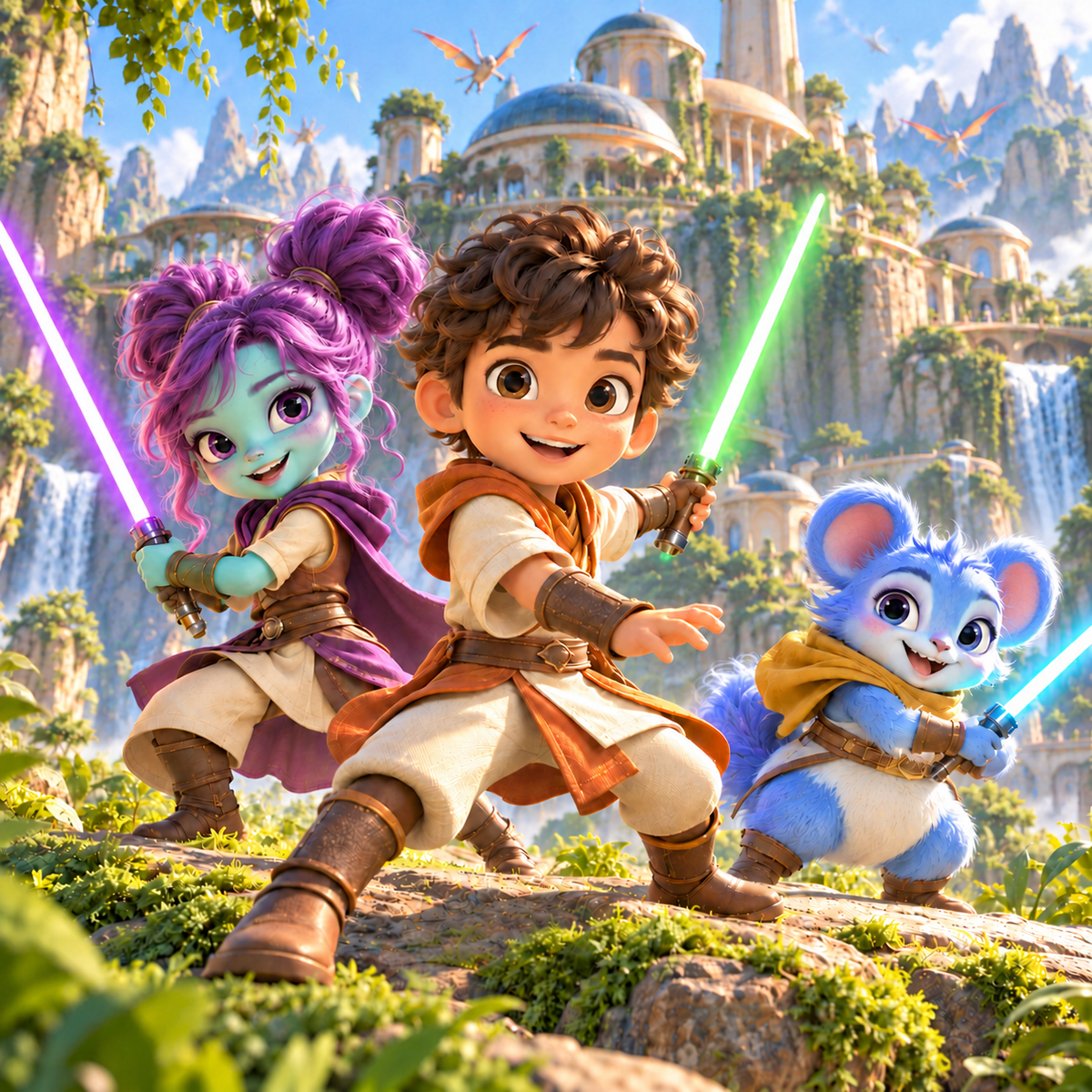
- The main young Jedi are Kai Brightstar, Lys Solay, and Nubs, who train at a Jedi temple on the planet Tenoo as they learn to use the Force, help others, and understand what it really means to be a Jedi.
- Key supporting characters include Master Zia Zanna, young pilot Nash Durango, her droid RJ-83, and familiar Jedi figures like Yoda.
- The series focuses less on galactic war and more on teamwork, compassion, problem-solving, responsibility, exploration, creatures, pirates, and small-scale adventures.
- Although it is a Star Wars kids series, its High Republic setting gives viewers a useful introduction to an era that looks very different from the Clone Wars, the Empire, or the Skywalker-focused periods.
Proof & Sources
The series and its setting are documented through official Star Wars material. The key to understanding the timeline is that Young Jedi Adventures takes place during the High Republic, long before the rise of the Empire and the events surrounding Anakin Skywalker.
Where exactly does a colorful children's adventure about young Jedi fit into a galaxy filled with Sith Lords, Clone Wars, fallen Republics, and the Skywalker family?
Young Jedi Adventures takes place in a very different Star Wars galaxy.
The easiest way to understand Star Wars Young Jedi Adventures is to forget the Empire for a moment. Darth Vader hasn't risen, Luke Skywalker hasn't been born, the Clone Wars haven't begun, and the Jedi haven't yet been reduced to a handful of survivors. Instead, the series takes place during the High Republic, a period when the Jedi Order is active across the galaxy and openly serves communities as explorers, protectors, negotiators, teachers, and guardians of peace.
That setting changes the story's entire mood. In many Star Wars films, Jedi appear during periods of crisis. The prequel trilogy shows an Order being drawn into war and political instability, while the original trilogy presents the Jedi as almost extinct. Young Jedi Adventures lets viewers see something much closer to the ideal the Jedi are supposed to represent: an institution stable enough to train young students, maintain temples, travel to distant worlds, and help people before every problem becomes a military emergency.
The peaceful setting does not mean nothing dangerous happens. The young characters still encounter pirates, difficult creatures, damaged ships, competitions, misunderstandings, and people making selfish decisions. The difference is scale. These stories usually focus on how a Jedi should respond to a problem rather than surviving a galaxy-wide war. That makes the series particularly useful for understanding Jedi values before later historical events put them under much greater pressure.
Where is Young Jedi Adventures on the Star Wars timeline?
The series is set roughly 200 years before The Phantom Menace, placing it within the High Republic era. That means Kai, Lys, Nubs, and their teachers live generations before Obi-Wan Kenobi trains Anakin Skywalker and long before Luke begins his journey on Tatooine. The Republic already exists, and the Jedi are an established galactic institution, but the political and military environment differs greatly from the final decades shown in the prequel films.
This timeline position matters for new viewers because familiar Star Wars expectations don't always apply. No Galactic Empire controls the galaxy, no Rebel Alliance fights against it, and no Clone Army marches alongside Jedi Generals. The series takes place when the Republic is expanding its connections and the Jedi can serve local populations more broadly, rather than functioning primarily as wartime commanders.
The High Republic is itself a large storytelling era rather than one single moment. Other books, comics, and stories explore serious conflicts and more mature themes within that period. Young Jedi Adventures approaches the era from a younger perspective, focusing on students and local adventures rather than requiring its audience to understand every major political development occurring elsewhere in the High Republic timeline.
Read more: High Republic Lightsabers vs Old Republic: What’s the Difference?
Tenoo is the young Jedi's everyday home.
Much of the series revolves around Tenoo, where the young Jedi continue training under the guidance of experienced Masters. This gives the show a stable home base even when individual episodes take the characters into space, nearby settlements, forests, mountains, or other environments.
Tenoo is important because it shows Jedi life outside the enormous temple on Coruscant that dominates the prequel-era image of the Order. The Jedi are not presented as existing only at one galactic headquarters. Their presence can be spread across different worlds, allowing students and Masters to interact directly with the communities they serve.
For Kai, Lys, and Nubs, the temple is not simply a school where they practice lightsaber moves. It is where they learn patience, responsibility, cooperation, and how to interpret Jedi teachings. Their adventures often begin with a practical problem, but the real challenge is usually emotional or ethical. Learning when to listen can matter as much as learning how to move an object with the Force.
Kai Brightstar is the group's energetic center.
Kai Brightstar is one of the main faces of the series and often embodies the excitement a young student might feel about becoming a Jedi. He is courageous, enthusiastic, and eager to act, qualities that make him naturally suited to adventure but also open him up to mistakes.
Kai's stories frequently explore the difference between bravery and impulsiveness. Wanting to help is not enough if someone rushes ahead without understanding the situation. The series uses his enthusiasm to show younger viewers that becoming more capable does not simply mean learning stronger Force abilities. It also means knowing when to slow down, think, cooperate, and recognize that someone else may have a better idea.
This makes Kai a useful entry point for audiences unfamiliar with Jedi philosophy. He often approaches situations the way an excited viewer might: see the problem, grab the lightsaber, and solve it immediately. The lesson is that a Jedi's first responsibility isn't always to fight. Sometimes the most Jedi-like choice is to listen, protect, negotiate, rescue, or help someone understand the consequences of their actions.
Lys Solay brings observation and empathy into the team.
Lys Solay balances Kai's energy with a personality that is often especially attentive to living creatures and the emotional details of a situation. Her presence emphasizes that Jedi abilities aren't valuable only during combat. Understanding animals, noticing fear, and recognizing when someone needs reassurance can matter as much as lifting an object or blocking danger.
This becomes particularly meaningful because the series frequently includes creatures in its adventures. Rather than treating every unfamiliar animal as a monster that must be defeated, Lys often encourages a more compassionate interpretation. A creature causing trouble may be frightened, protecting something, or reacting to circumstances the characters initially failed to understand.
That perspective fits the broader Jedi ideal of seeking knowledge before using the Force. In a children's series, the principle can be communicated through a straightforward creature rescue. In the larger Star Wars mythology, however, it reflects an important distinction between a Jedi acting as a guardian and a warrior who treats every obstacle as an enemy.
Nubs proves that personality does not depend on size.
Nubs is one of the most immediately recognizable Young Jedi Adventures characters because of his small size, blue fur, expressive behavior, and physical enthusiasm. He adds humor, but he isn't simply comic relief.
Nubs repeatedly demonstrates courage and loyalty despite being physically smaller than many of the beings around him. His role reinforces one of Star Wars' oldest themes: appearance is a poor measure of capability. Yoda established the same idea in a very different context, and Nubs gives a younger audience another version of it.
His friendship with Kai and Lys also prevents the team from feeling like one central hero surrounded by assistants. The young Jedi solve problems together, and different situations let different members step up. This emphasis on teamwork is central to the educational purpose of the series and also fits naturally with Jedi training, where cooperation should matter more than individual glory.
Master Zia Zanna represents the Jedi as teachers.
Master Zia Zanna matters because Young Jedi Adventures needs an adult Jedi presence who guides the students without solving every problem for them. If a powerful Master stepped into each episode and fixed everything, the young characters would have little opportunity to grow.
Her role is therefore often to create structure rather than replace the students' choices. She gives advice, provides training, explains Jedi principles, and allows the younglings enough independence to discover why those principles matter.
This is one of the clearest differences between the series and stories centered on experienced Jedi Knights. Kai, Lys, and Nubs aren't supposed to know the right answer right away. Their mistakes are part of the narrative design.
Master Zia helps transform those mistakes into lessons, showing what Jedi mentorship can look like during a relatively stable period of the Order.
Yoda connects the series to the larger Star Wars timeline.
Yoda's presence provides one of the easiest connections between the High Republic setting and the later films. Because Yoda lives for centuries, he can exist naturally in both periods without requiring time travel or complicated continuity explanations.
For younger viewers, Yoda may be a wise Jedi Master who occasionally helps the characters. For older Star Wars fans, his presence creates a powerful sense of historical continuity. The Yoda of this hopeful period will eventually witness the Republic's decline, the Clone Wars, Order 66, and the near destruction of the Jedi.
That later history doesn't dominate Young Jedi Adventures, and it shouldn't. The series works because it allows the High Republic to be experienced on its own terms. Yet longtime viewers can't fully separate Yoda from what they know will happen centuries later, giving even a simple appearance an added layer of meaning.
Nash Durango proves the story is not only about Jedi.
Nash Durango is one of the most important non-Jedi characters in the series. As a young pilot and friend of the Jedi students, she gives the group access to adventures beyond temple training.
Her presence also prevents the story from suggesting that only Force-sensitive people can be brave or important. Nash contributes through piloting, practical knowledge, determination, and friendship. She can take part in the same missions without needing a lightsaber or Jedi powers.
That is a valuable idea within Star Wars generally. Some of the saga's most important heroes, including Han Solo, Leia Organa, Poe Dameron, and many Rebel fighters, are not defined by Jedi training. Young Jedi Adventures introduces that same principle in a simpler form: being a hero depends on choices and abilities, not on whether someone can use the Force.
RJ-83 adds another classic Star Wars ingredient
Nash's droid RJ-83 continues the long Star Wars tradition of giving mechanical companions recognizable personalities. From R2-D2 and C-3PO to BB-8 and Chopper, droids often provide humor, assistance, information, and emotional familiarity.
RJ-83 fits naturally into this tradition while serving a younger series. The droid reinforces the sense that technology is part of everyday galactic life rather than separate from the characters' adventures.
Including a droid companion also makes the world feel like Star Wars right away, even when an episode isn't focused on familiar planets or legacy characters. Starships, lightsabers, droids, alien species, and the Force work together as recognizable pieces of the larger universe.
Taborr introduces conflict without turning the series into a war story.
The young Jedi need recurring opponents, but the series' tone would change completely if every adventure involved Sith Lords or armies trying to destroy the Republic. Taborr provides a more age-appropriate kind of antagonist through piracy, competition, theft, and rivalry.
This creates conflict that can remain exciting without making every encounter a life-or-death battle. Taborr can challenge the young Jedi's patience, judgment, and ability to respond when another young person chooses selfish behavior.
It also gives the series space to explore a theme central to Jedi storytelling: defeating someone isn't always the same as solving the problem. A Jedi may need to stop harmful behavior while still understanding the person responsible.
The approach keeps the adventures accessible while staying consistent with the broader idea that Jedi protect rather than punish.
The series is about learning to be a Jedi, not simply learning to fight.
Lightsabers are a natural part of Star Wars: Young Jedi Adventures, and the young characters receive training in how to use them. Yet combat isn't the only measure of progress.
An episode can teach patience through a rescue, responsibility through a mistake, cooperation through a competition, or empathy through an encounter with a creature. These are all framed as part of Jedi development.
That distinction matters because many later Star Wars stories show Jedi primarily in combat-heavy historical periods. The Clone Wars, in particular, places Jedi at the front of enormous military campaigns, which can make it easy to forget that the Order originally defined itself around peacekeeping and service.
Young Jedi Adventures returns to that earlier ideal in a form children can understand.
What do the lightsabers tell us about the young Jedi?
The young Jedi carry lightsabers that make them visually recognizable as members of the Order. Still, the series does not need every blade color to function as a complicated personality classification. The weapons are part of their training and identity as they develop as Jedi.
This matters because internet discussions often assign extremely rigid meanings to lightsaber colors. Star Wars canon does not support every personality chart circulating online.
In Young Jedi Adventures, the more important question is how the characters learn to use the weapons responsibly. A lightsaber gives a young Jedi enormous capability, so self-control matters more, not less.
The series repeatedly prioritizes character development over treating the saber as a simple power upgrade.
Read also: How Star Wars: Young Jedi Adventures Tells Tales for Younglings of All Ages
How the series presents the Force to children
The Force can be an abstract concept even for adult viewers. Star Wars describes it spiritually, characters experience it emotionally, and different traditions interpret it differently. A preschool-oriented series can't start with complicated debates about the Force's cosmic and living aspects.
Instead, Young Jedi Adventures makes the Force understandable through action. The characters concentrate, sense things, move objects, help one another, and learn that emotional control affects how effectively they respond.
This provides a simple foundation without requiring the series to redefine the mythology. Younger viewers understand that the Force is powerful but should not be used carelessly.
The moral component matters as much as the supernatural one. Jedi training is not simply about gaining abilities. It is about learning when and why to use those abilities.
Why compassion appears so often in the stories
Compassion is one of the easiest Jedi values to translate into a children's adventure. A character sees someone in trouble, chooses to help, and learns that understanding another person can change the outcome.
Yet this simple lesson matters deeply to the larger saga. Many of Star Wars' most important conflicts revolve around characters failing or succeeding to act compassionately.
Luke's compassion toward Darth Vader ultimately becomes more important than simply defeating him. By contrast, the prequel era repeatedly shows how fear, secrecy, and rigid thinking can damage relationships.
Young Jedi Adventures introduces the positive principle before younger viewers encounter those more complicated failures elsewhere in the franchise.
Teamwork matters because the young Jedi are still learning
Kai, Lys, and Nubs are capable, but the series rarely pretends one of them is an unstoppable prodigy who can handle every situation alone.
Their adventures frequently depend on combining strengths. One student may notice something another missed. Someone may need to admit a mistake, ask for help, or trust a friend's plan.
This makes teamwork part of the Jedi lesson rather than merely a convenient plot device. Learning to work with others requires humility, and humility is especially important for people developing extraordinary abilities.
If the Force let a student believe they never needed anyone else, Jedi training would create arrogance instead of wisdom.
The group structure constantly pushes against that possibility.
The stories are intentionally smaller than most Star Wars conflicts.
A common mistake is judging the series by asking why its villains aren't as threatening as Darth Vader or why its adventures don't have the stakes of the Clone Wars.
That comparison misses the show's purpose. A story about young Jedi learning responsibility should not need a planet-destroying superweapon every week.
Smaller problems are more appropriate because they keep the consequences understandable. A lost object, damaged ship, endangered animal, unfair competition, or pirate scheme gives the characters enough difficulty to make a meaningful decision without pushing the series outside its intended audience.
The result resembles early training rather than galactic warfare, which is exactly what the setting requires.
Is Young Jedi Adventures canon?
Yes, Young Jedi Adventures belongs to the modern Star Wars continuity rather than functioning as a completely separate parody or non-canon preschool universe.
Its younger tone doesn't change that status; many audiences underestimate it because of the animation and the young characters, assuming serious continuity exists only in live-action films. Star Wars has repeatedly used animation for significant canon storytelling, including The Clone Wars, Rebels, The Bad Batch, and other productions.
Young Jedi Adventures targets a different age group, but that difference affects presentation rather than automatically removing the series from continuity.
How closely is it connected to other High Republic stories?
The easiest answer is that it shares the broad High Republic era without requiring younger viewers to understand the more complicated stories told in novels and comics.
The High Republic contains numerous Jedi, worlds, political developments, threats, and historical events. Some parts of that publishing initiative target older children, teenagers, or adults and therefore deal with much more danger than Young Jedi Adventures.
The animated series approaches the same broad age of Jedi confidence from a local and youthful perspective.
That means viewers can understand Kai, Lys, and Nubs without first completing a High Republic reading list. Knowledge of the wider era can add context, but it isn't required to follow the show.
Does the series lead directly into The Phantom Menace?
Not in the sense of functioning as an immediate prequel. A large historical gap separates the young Jedi's adventures from the beginning of the Skywalker-era films.
The timeline connection is more thematic. Young Jedi Adventures shows an earlier Jedi Order with greater reach and optimism. The Phantom Menace begins much later, when the Republic and Jedi are moving toward the political conditions that eventually produce the Clone Wars.
Watching the earlier setting can therefore make the later decline feel larger. The audience knows the Jedi weren't always generals fighting a desperate war.
They once had enough stability for young students to learn through exploration and community service.
The High Republic setting gives the Jedi room to feel hopeful.
Hope is one of the defining differences between this period and the later Skywalker-era crises. The Jedi aren't living as fugitives, and their temples aren't memories of a destroyed institution.
For a Star Wars kids series, this is especially useful. Young viewers can meet the Jedi through their ideals before confronting the tragedy of their fall.
The Order can be presented as something worth aspiring to: people who try to remain calm, protect others, understand unfamiliar situations, and use great power responsibly.
Older viewers may experience the same scenes differently because they know how the institution eventually changes. That dramatic irony adds depth without needing explanation within the episodes themselves.
Why the show does not need Sith villains to feel like Star Wars
Lightsabers often lead audiences to expect Jedi-versus-Sith battles, but the Order's history is much larger than that rivalry.
Even when the Sith aren't openly dominant, the Jedi still have work to do. Ships crash, communities need help, disputes emerge, criminals cause trouble, creatures become endangered, and exploration creates unexpected problems.
Showing Jedi responding to these situations actually broadens our understanding of what the Order exists to accomplish.
If every Jedi story required a red lightsaber on the other side, the peacekeeping role would be hard to believe.
Young Jedi Adventures shows that Jedi life can still be exciting even when the enemy isn't always another Force-user.
Why adults can understand more of the setting than the target audience
The series is clearly designed to remain accessible to young children, but older Star Wars fans bring additional context.
A child may see Yoda as a wise teacher. An adult may see someone who will still be alive when the Jedi Order collapses centuries later.
A child may see a thriving Jedi temple as a safe home. An experienced fan knows that later Star Wars history will make functioning Jedi institutions increasingly rare.
Neither perspective invalidates the other. The series works on a simple narrative level, while the wider timeline adds historical resonance for franchise fans.
This is one reason the High Republic setting was a strong choice: it lets the show stay optimistic without contradicting the darker history that comes later.
Is Young Jedi Adventures only for preschool viewers?
Its storytelling, episode structure, humor, and moral lessons are clearly designed for younger children, so adult viewers expecting the narrative complexity of Andor or the darker arcs of The Clone Wars will approach the series with the wrong expectations.
That does not mean older fans have nothing to gain from it.
The show offers a simple view of High Republic Jedi life, introduces a new generation of younglings, and shows how Star Wars concepts can translate for viewers encountering the franchise for the first time.
Parents who already know the saga may also find it a useful shared entry point before introducing more intense films or animated series.
Is it a good introduction to Star Wars for children?
The series avoids many elements that can make other Star Wars stories intense for very young audiences. Its conflicts are usually easier to understand, the heroes are close to the intended viewers' age, and the moral consequences are presented clearly.
At the same time, the show preserves recognizable Star Wars elements. There are Jedi, lightsabers, Force abilities, droids, starships, alien worlds, pilots, pirates, and adventurous journeys.
That combination lets a child learn the franchise's visual and moral vocabulary without starting with Darth Vader, large-scale warfare, or the destruction of entire planets.
In that sense, Young Jedi Adventures can function as a genuine first step into a much larger universe.
Do you need to know the High Republic before watching?
No. The series is designed so that its basic stories make sense without outside reading.
Knowing the setting is the High Republic helps place it on the timeline. Still, the characters don't require viewers to understand every historical event happening elsewhere during the era.
This independence is especially important for a children's program. Requiring several novels and comics before an episode about Kai, Lys, and Nubs would undermine the accessibility the show is trying to create.
Older fans can add outside context if they want, but the core story remains self-contained enough for a new viewer.
How should the series be watched?
Because many episodes focus on individual adventures and lessons, the show is more episodic than a heavily serialized Star Wars drama. A viewer can often understand a story without remembering every previous detail.
However, watching in release order still makes the most sense because relationships, skills, and familiarity naturally build over time.
The characters gradually feel more experienced because the audience has watched them make earlier mistakes and learn from them.
This matters especially for Kai, Lys, and Nubs because the series is about development. Their progress may be gentle, but the idea that Jedi training happens over time is part of the experience.
What does the series add to the image of Jedi training?
Most famous Jedi training scenes are unusually intense. Luke trains with Yoda while preparing to confront the Empire. Anakin trains as the galaxy rapidly heads toward war. Ahsoka becomes a Padawan shortly before the Clone Wars.
Young Jedi Adventures offers another possibility.
Training can include community service, friendship, learning how to treat creatures, accepting correction from a teacher, or understanding that personal competition shouldn't become selfishness.
That makes Jedi education feel broader and more believable.
A large Order that exists for generations would need to teach emotional maturity alongside combat technique. The series makes that everyday educational process visible.
Why the characters are more important than galactic politics
The High Republic has major political and historical stories, but this series doesn't need to make Kai, Lys, and Nubs participants in every significant galactic event.
Their small scale is a strength.
Children learning to become Jedi should experience the galaxy through relationships before they become responsible for major institutions. A friendship problem can teach honesty. A rescue can teach courage. A mistake can teach accountability.
Those lessons form the foundation for the larger ethical decisions an experienced Jedi may eventually need to make.
By focusing on characters before politics, the series presents Jedi philosophy in its most approachable form.
What Young Jedi Adventures reveals about Star Wars as a franchise
Star Wars has always been flexible enough to support very different tones. The same universe can include political drama, war stories, mysticism, comedy, western-inspired adventures, animation, and stories for very young children.
Young Jedi Adventures shows that the franchise's identity doesn't depend entirely on darkness or galactic catastrophe. A Jedi helping a frightened creature can still feel Star Wars recognizably if the story preserves the values, technology, worlds, and visual language of the larger saga.
That flexibility also helps explain why the High Republic works particularly well for the series. It offers enough familiar Jedi imagery to stay recognizable while distancing itself from the conflicts audiences already know from the films.
The result is a corner of Star Wars where a lightsaber can symbolize learning before it symbolizes war. 👉 Explore more lightsabers here.
For longtime fans, that perspective can be surprisingly useful. Later stories show what happens when the Jedi Order becomes involved in political crisis and military leadership. Watching younglings train during a more hopeful period reminds us that those later conditions were not supposed to be normal Jedi life.
Younger viewers don't need any of that historical tragedy. Kai, Lys, Nubs, Nash, Master Zia, and their friends can represent adventure, curiosity, cooperation, and the challenge of learning how to use power responsibly.
That is ultimately where Star Wars Young Jedi Adventures fits best in the larger franchise. It is a canon High Republic story built as an accessible first encounter with Jedi ideals. Its stakes are smaller than the Skywalker saga. Still, its central question is the same one Star Wars keeps asking across generations: when you can act, what kind of person will you choose to become?
FAQs
What is Star Wars: Young Jedi Adventures about?
The series follows young Jedi students, including Kai Brightstar, Lys Solay, and Nubs, as they train, explore the galaxy, help others, and learn what it means to live by Jedi values.
When does Young Jedi Adventures take place?
It is set during the High Republic era, roughly two centuries before The Phantom Menace.
Is Young Jedi Adventures canon?
Yes. The series belongs to the modern Star Wars continuity despite being designed primarily for younger children.
Who are the main characters in Young Jedi Adventures?
Kai Brightstar, Lys Solay, and Nubs are the central young Jedi, while Master Zia Zanna, Nash Durango, RJ-83, Yoda, and recurring rivals and allies support their adventures.
Who is Kai Brightstar?
Kai is an enthusiastic young Jedi student whose courage and eagerness often lead him into situations that teach him patience, teamwork, and better judgment.
Who is Lys Solay?
Lys is a young Jedi known for empathy and attentiveness, especially when dealing with creatures and situations that require understanding rather than immediate confrontation.
Who is Nubs?
Nubs is a small, blue-furred young Jedi and close friend of Kai and Lys. His courage and loyalty make him an important member of the group.
Who is Nash Durango?
Nash is a young pilot and friend of the Jedi students. She shows that characters don't need Force abilities to contribute meaningfully to adventures.
Who is Master Zia Zanna?
Master Zia is an experienced Jedi who guides and trains the young students on Tenoo.
Does Yoda appear in Young Jedi Adventures?
Yes. Yoda's long lifespan lets him appear naturally during the High Republic era, centuries before his later role in the Skywalker saga.
Where is Young Jedi Adventures set?
Tenoo is an important home base for the characters, though their adventures take them to different environments.
Is Young Jedi Adventures part of the High Republic?
Yes. It takes place during the broader High Republic era, though its stories are designed to be understandable without reading the High Republic novels or comics.
Does Young Jedi Adventures have Sith?
The series does not depend on Jedi-versus-Sith conflict as its central premise. Instead, many stories involve pirates, local problems, creatures, rescues, and challenges tied to Jedi training.
Is Young Jedi Adventures connected to The Phantom Menace?
It belongs to the same overall continuity but takes place roughly 200 years earlier, so it is not an immediate prequel to the film.
Is Young Jedi Adventures only for children?
It is primarily designed for younger viewers, but older Star Wars fans can still appreciate its High Republic setting, Jedi lore, and connections to the larger timeline.
Do I need to know Star Wars before watching Young Jedi Adventures?
No. The series is designed to be accessible to viewers who may be encountering Star Wars and the Jedi for the first time.
Do I need to read High Republic books before watching?
No. The show uses the High Republic setting but tells stories you can follow on your own.
Why is Young Jedi Adventures important to Star Wars lore?
It offers a rare look at young Jedi training during a time when the Order is widespread and relatively stable, emphasizing service, compassion, cooperation, and learning over galactic warfare.
Join the Nsabers Community
Bring the Force into your world with Nsabers.
✨ Follow Nsabers across the galaxy:
💬 We'd love to hear from you!
Share your thoughts, leave a comment below, or tag us on social media.
May the Force be with you!


Laat een reactie achter
Alle reacties worden gemodereerd voordat ze worden gepubliceerd.
Deze site wordt beschermd door hCaptcha en het privacybeleid en de servicevoorwaarden van hCaptcha zijn van toepassing.