

Quick Answers
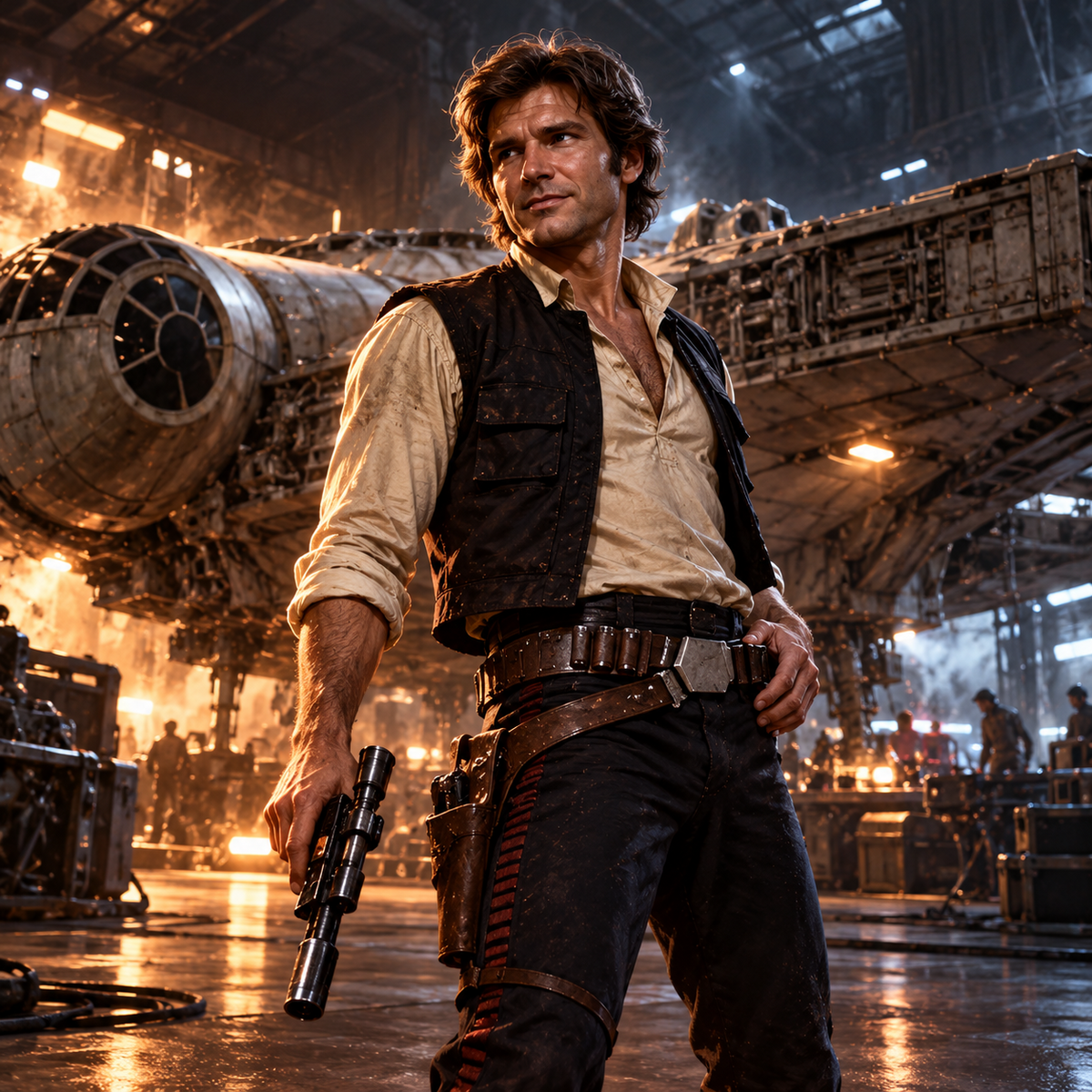
- Harrison Ford is best known for playing Han Solo, a smuggler who becomes a central hero of the original trilogy and later returns in the sequel era.
- Ford first played Han in Star Wars in 1977, followed by The Empire Strikes Back and Return of the Jedi, helping transform the character from a cynical mercenary into a committed member of the Rebel Alliance.
- Han Solo became one of Ford’s defining roles because his humor, skepticism, confidence, and vulnerability contrasted with the more mythic, Jedi-centered side of Star Wars.
- Ford returned as Han in The Force Awakens in 2015, where the character’s relationship with Leia, Chewbacca, and his son Ben Solo gave his story a more tragic final chapter.
- Ford also appeared in The Rise of Skywalker in a memory sequence with Ben Solo, reinforcing Han’s importance to his son’s emotional journey even after Han’s death.
- The legacy of the Han Solo actor in Star Wars extends beyond one character: Ford helped establish the grounded, sarcastic human perspective that became an essential part of the franchise’s storytelling identity.
Proof & Sources
Harrison Ford’s history with Star Wars can be traced through official profiles of Han Solo and the films in which the character appears, while biographical sources document Ford’s wider career and the importance of the role to his rise as a major Hollywood actor.
- Han Solo – Star Wars Databank
- Millennium Falcon – Star Wars Databank
- Harrison Ford – Encyclopedia Britannica
How did an actor who played a skeptical smuggler with no interest in Jedi philosophy become one of the most important faces in Star Wars history?
Harrison Ford Gave Star Wars a Different Kind of Hero
When audiences first meet Han Solo in the original Star Wars, he doesn't look or act like the traditional hero at the center of a myth. He sits in a cantina, haggles over money, worries about debts, and presents himself as someone who survives by staying practical. Harrison Ford’s performance immediately separates Han from Luke Skywalker’s optimism and Obi-Wan Kenobi’s connection to the Jedi. Han doesn't start by believing in destiny. He believes in getting paid, keeping the Millennium Falcon flying, and escaping trouble before it becomes fatal.
That contrast became a foundation of the original trilogy. Star Wars needed characters who believed in the Force, but it also benefited enormously from having someone who doubted everything around him. Ford gives Han a constant sense that the galaxy is strange, dangerous, and often absurd, even when everyone else discusses prophecy, Rebellion, or mystical power. His reactions create a human scale for a story filled with enormous ideas, making the fantastic world easier for audiences to enter.
The success of the Harrison Ford Han Solo role comes partly from this tension. Han is never simply comic relief, and he is never simply the cool pilot standing beside the real heroes. His skepticism becomes meaningful because the story gradually forces him to decide what he actually believes in. He can dismiss the Force, mock idealism, and insist he cares only about himself, but his actions repeatedly reveal that his loyalties run deeper than his words.
Ford Was Not Yet the Harrison Ford Audiences Know Today
It is easy to look backward at the original Star Wars and imagine Harrison Ford arriving as an already established movie star. In 1977, however, the situation looked very different. Ford had acted before, including in George Lucas’s American Graffiti. Still, he was not yet the globally recognizable leading man who would later become associated with Han Solo, Indiana Jones, Rick Deckard, and numerous other major roles.
That context matters because Han Solo didn't simply benefit from Ford’s existing star image. The role helped create that image. Audiences encountered a performer who could deliver sarcasm without making the character emotionally empty, project confidence without making Han invulnerable, and shift from comedy to danger within the same conversation. The qualities later associated with Ford’s screen persona were already visible in the character, but a mass audience was still discovering them.
Ford’s casting also became part of Star Wars history because he had worked with Lucas and was involved in the audition process before becoming the final choice for Han. Whatever mythology has grown around the details over the decades, the outcome is clear: the actor and character became so closely connected that it is now hard to imagine the original trilogy producing the same emotional effect with someone else in the role.
Read more: The Touching Story of How Harrison Ford Became Han Solo (By Accident)
Why Han Solo Needed Harrison Ford’s Skepticism
Han’s dialogue could easily have become too cynical in another performance. A character who repeatedly questions the heroes, focuses on payment, and dismisses mystical ideas risks appearing selfish or unpleasant. Ford prevents that by letting tiny signs of affection, amusement, nervousness, and concern surface beneath Han’s confident surface.
When Han boasts, the audience often senses that part of the performance is deliberate self-presentation. He wants to be seen as the pilot who always has control, even though the Millennium Falcon frequently malfunctions and his plans often collapse almost immediately. Ford understands the comedy of that contradiction without turning Han into a fool.
That balance is essential. Han can make outrageous claims about the Falcon or complain about impossible odds while remaining genuinely capable. The humor comes from personality, not incompetence. As a result, audiences can laugh at him and still believe that he is one of the people they would most want nearby when a plan goes wrong.
Han Solo’s Relationship With Luke Defines His First Transformation
Luke and Han begin with radically different ideas about the galaxy. Luke wants adventure and believes that life can have a greater purpose. Han believes experience has taught him to distrust exactly that kind of idealism. Their relationship therefore becomes more than simple friendship. Luke represents the kind of commitment Han insists he doesn't understand, while Han represents the practical survival instinct Luke hasn't yet developed.
Ford plays this relationship without making Han suddenly abandon his personality. Even as affection grows, Han keeps teasing Luke and resists openly sentimental language. That makes his moments of loyalty more powerful because he shows it through action rather than speeches.
His return during the Battle of Yavin is the clearest example. Han has already received his reward and has every practical reason to leave. When he comes back to help Luke, the decision reveals that the cynical identity he has been presenting is no longer complete. He has become invested in people and causes beyond himself, even if he still refuses to describe the change in heroic language.
Chewbacca Makes Han More Human
You can't understand Han Solo without Chewbacca. The Wookiee is not simply his copilot or sidekick; their relationship demonstrates that Han was capable of loyalty long before the Rebel Alliance entered his life. Ford’s performance becomes most revealing around Chewie because Han treats him as an equal, even though the audience cannot understand Chewbacca’s spoken language the way Han can.
Their arguments feel lived-in. Han complains, Chewbacca responds, and the rhythm suggests years of shared experiences that happened before the film began. That sense of history is one reason the Millennium Falcon feels like a home rather than just a vehicle. Han, Chewie, and the Falcon form a small unit before Luke, Leia, and the Rebellion expand Han’s world.
Ford also uses Chewbacca to expose Han’s emotional side without changing the character’s style. Concern can be disguised as irritation, affection as teasing, and fear as another argument. As a result, their relationship rarely needs direct statements of friendship because their behavior already makes the bond obvious.
Leia Organa Challenges Every Defense Han Has Built
Han’s relationship with Leia is one of the most important reasons the character grows beyond the charming smuggler introduced in the first film. Leia does not accept his self-image at face value. She sees his arrogance, questions his motives, and refuses to be impressed simply because he thinks he's charming.
Ford and Carrie Fisher make the conflict work because attraction and irritation are present at the same time. Their scenes are rarely straightforward romantic conversations. They are contests in which both characters test each other, hide vulnerability, and use humor as protection. The tension is entertaining, but it also serves Han’s larger development.
Leia represents something Han cannot comfortably reduce to a transaction. His feelings for her Force him to confront emotional commitments he can't manage like a smuggling contract. As The Empire Strikes Back progresses, his decisions increasingly revolve around protecting people rather than escaping danger. The man who once insisted on being paid becomes willing to stay in situations with no financial reward at all.
“I Know” Became the Perfect Han Solo Response
One of the most famous moments in The Empire Strikes Back occurs before Han is frozen in carbonite. Leia finally tells him, “I love you,” and Han responds, “I know.” The line became iconic because it captures his entire emotional personality in two words.
A more conventional romantic response might have expressed exactly what Han felt, but Han is not a conventional romantic hero. Even when facing possible death, he maintains the communication style that has defined his relationship with Leia. The response is confident, affectionate, slightly arrogant, and emotionally restrained.
Ford’s delivery is crucial. Written on a page, “I know” could sound dismissive. In the scene, it does not. The expression and timing allow the audience to understand the feeling beneath the words. That ability to communicate more than the dialogue literally states is one of Ford’s greatest contributions to Han Solo.
The moment also demonstrates why performance matters when discussing Harrison Ford in Star Wars. Han’s identity is not created only by plot or costume. It lives in pauses, reactions, body language, and the particular rhythm with which Ford delivers a line.
The Empire Strikes Back Turns Han Into a Romantic and Tragic Hero
The second film gives Han far more emotional responsibility than the first. He is still funny and argumentative, but the story repeatedly places him in situations where escape becomes impossible. He must protect Leia, keep the Falcon functioning, confront betrayal, and ultimately face capture by the Empire.
This makes The Empire Strikes Back especially important to the character’s legacy. Han begins the film by saying he intends to leave the Rebellion because of the bounty on his head. Yet, much of what follows is defined by his inability to abandon the people around him. His stated desire for independence increasingly conflicts with his attachments.
Ford keeps that contradiction alive throughout the film. Han never transforms into Luke. He does not suddenly adopt idealistic language or become fascinated by the Force. His heroism remains recognizably Han Solo’s: practical, reluctant to announce itself, and usually expressed by choosing to stay when leaving would be easier.
Return of the Jedi Shows a Han Who Has Chosen His Side
By Return of the Jedi, Han is no longer the outsider negotiating whether the Rebellion deserves his participation. He has become part of the group. His role in the mission against the second Death Star reflects how far the character has moved from the mercenary introduced on Tatooine.
Ford still preserves the personality audiences recognize. Han remains sarcastic, competitive, and occasionally impatient. The change is not that his entire temperament disappears. Instead, those qualities now exist in a committed Rebel leader rather than a man insisting he owes nothing to anyone.
This continuity matters because character development can feel artificial when growth erases everything that once made a person distinctive. Han’s evolution works because the same man is present throughout. He makes different choices once he has something larger than himself to protect.
By the end of the original trilogy, his journey is not from “bad person” to “good person.” It is from emotional isolation to belonging. He begins with Chewbacca and the Falcon as his protected world and ends with friendships, love, and a cause that have become inseparable from his identity.
The Millennium Falcon Is Almost an Extension of Han
Few actor-character relationships in Star Wars are as closely tied to a vehicle as Harrison Ford’s Han Solo is to the Millennium Falcon. The ship is technically machinery, yet it functions narratively like an extension of Han’s personality. It looks unreliable, has a complicated history, is frequently underestimated, and somehow performs extraordinary feats when circumstances become desperate.
Han’s pride in the Falcon also tells us how he sees himself. When other characters insult the ship, he takes the criticism personally. The Falcon may not look impressive by conventional standards, but Han knows what it can do because he understands it better than outsiders.
Ford sells this relationship through familiarity. Han moves through the ship as someone who knows its problems, sounds, shortcuts, and limitations. When something breaks, his frustration feels routine rather than surprising. That makes the Falcon feel inhabited and gives the audience the sense that Han has lived a complete life before entering the main plot.
The ship later becomes one of the most powerful visual tools for reintroducing Han in the sequel era. Seeing the Falcon again immediately reconnects the character with his earlier identity, even before the story explains everything that has happened in the intervening decades.
Why Ford’s Han Worked So Well Beside the Jedi Mythology
Star Wars combines myth, fantasy, war film, adventure serial, and science fiction. Han Solo gives that mixture a necessary counterweight. Luke can discuss the Force with sincerity because Han is nearby to ask why anyone should believe it. Obi-Wan can speak in mythic language because Han responds from the perspective of someone used to debts, engines, blasters, and survival.
This does not weaken the spiritual side of Star Wars. It strengthens it. A belief becomes more meaningful when the story includes someone who can doubt it. Han’s skepticism gives Luke’s faith something to push against and gives the audience permission to stay uncertain as they learn the rules of the galaxy.
Ford’s naturalistic performance also grounds highly stylized material. He frequently reacts to extraordinary situations as if they are inconvenient problems rather than cosmic events. That contrast became an important template for later Star Wars characters who combine humor with genre spectacle.
Han Solo Helped Create the Harrison Ford Screen Persona
After Star Wars, Ford became closely associated with protagonists who are capable but imperfect, skeptical but ultimately principled, and often visibly irritated by the dangerous circumstances around them. Indiana Jones is very different from Han Solo, but audiences can recognize certain qualities connecting the performances.
That does not mean Ford plays the same character repeatedly. Instead, Han helped demonstrate the effectiveness of a particular screen presence: a hero who doesn't need to sound heroic every moment. Ford makes courage more convincing by letting the character complain, hesitate, make mistakes, and occasionally look like he would rather be anywhere else.
The approach had a lasting influence on blockbuster protagonists. Many later adventure heroes combine humor, resistance to authority, visible frustration, and eventual moral commitment. Han Solo didn't invent every part of that archetype, but Ford’s performance made the combination enormously influential in modern popular cinema.
Read also: Does Leia Use a Lightsaber
Why Harrison Ford Returned for The Force Awakens
When The Force Awakens arrived in 2015, Ford returned to a character he had first played almost four decades earlier. The decision mattered because the film wasn't simply reviving Han for a nostalgic cameo. Han became a central link between the original generation and the new characters entering the story.
His reintroduction deliberately echoes the past. Han is once again associated with Chewbacca and eventually returns to the Millennium Falcon, but everything that has happened since Return of the Jedi complicates the similarities. He is older, his family has fractured, and the classic smuggler's confidence now sits alongside regret.
Ford plays the older Han as recognizably the same person, while letting age and loss show. The humor returns, but it does not erase the sadness. This version of Han has learned that winning a war did not guarantee a simple life afterward.
That is what prevents the performance from functioning purely as nostalgia. The audience receives the pleasure of seeing Han Solo again while also confronting the cost of the years that have passed.
Han and Leia’s Later Story Changes the Meaning of the Original Trilogy
The sequel era reveals that Han and Leia’s relationship didn't end with a permanent happy ending. Their son, Ben Solo, fell to the dark side and became Kylo Ren, creating an emotional wound that separated the family.
For Han, the tragedy produces a familiar response: retreat into the life he understands. Returning to smuggling seems like a way to escape the pain of what happened to Ben. The choice mirrors his original instinct to avoid emotional responsibility, but now the audience understands that the old lifestyle no longer truly fits him.
This gives Ford an interesting version of Han to play. He is not learning for the first time that other people matter. He already knows that. His challenge is whether he can face the consequences of loving people when those relationships lead to grief and failure.
The character’s final arc therefore revisits the original trilogy's themes from a more mature perspective. Young Han learns to stay. Older Han must learn to return after running away again.
The Relationship Between Han Solo and Ben Solo Defines His Ending
Han’s confrontation with Ben on Starkiller Base is the emotional center of his role in The Force Awakens. Han knows the person standing in front of him is Kylo Ren, a dangerous First Order leader, but he also sees his son.
This makes the scene very different from a typical hero-versus-villain confrontation. Han does not approach Ben primarily as an enemy to defeat. He approaches him as a father attempting to reach whatever remains of the child he remembers.
Ford strips away much of Han’s usual defensive humor during the encounter. The confidence and sarcasm that protect the character in other situations cannot solve this problem. Han has to speak directly, accept emotional risk, and offer his son the possibility of coming home.
His death completes the tragic side of the character’s journey, but it also confirms the moral transformation that began decades earlier. The man introduced while insisting that survival and money come first ultimately walks toward an armed dark-side warrior because that warrior is his son.
Why Han’s Death Was More Than a Shock
Han Solo was one of the most famous surviving characters from the original trilogy, so his death inevitably had enormous audience impact. Yet the scene matters because it is rooted in character rather than functioning only as surprise.
Han could have remained safely away from Ben. Instead, he chooses the most emotionally dangerous path available. The decision reflects everything the character has learned about loyalty, love, and responsibility. He cannot guarantee success, but he tries anyway.
This is also why Han’s final physical gesture toward Ben is so important. Even after being wounded, he responds as a father. The moment refuses to transform their relationship into a simple hero-versus-villain conflict.
Ford’s performance keeps the sequence intimate even as it unfolds within a massive science-fiction spectacle. The emotional scale narrows to two people whose history matters more than the surrounding weapons, armies, or galactic politics.
Harrison Ford’s Return in The Rise of Skywalker Completes Ben’s Memory of His Father
Ford reappears in The Rise of Skywalker at Ben Solo’s turning point. The film presents Han not as a conventionally resurrected character, but as an emotionally charged, memory-like encounter that echoes their earlier confrontation.
The scene deliberately reverses elements of The Force Awakens. Ben is again facing his father and again confronting the choice that defined his fall, but this time the emotional result changes. Han’s presence represents the relationship Ben could not destroy, even after killing him.
Ford doesn't need a long sequence to make the return feel significant. The audience already carries decades of history with the character and several films of emotional context surrounding the father-son relationship. A small exchange can therefore hold enormous weight.
Han’s importance to Ben also demonstrates how a character can continue shaping a story after death. His legacy is not limited to what he accomplished as a Rebel hero. It exists in the moral memory of the people who loved him.
Why Alden Ehrenreich Does Not Replace Harrison Ford’s Han Solo
Solo: A Star Wars Story needed another actor to portray Han earlier in his life, with Alden Ehrenreich taking on the younger version of the character. This creates an unusual situation because audiences already possess such a strong mental connection between Han Solo and Harrison Ford.
The purpose of a younger performance, however, is not simply to reproduce Ford’s gestures and voice. A younger Han has not yet experienced the original trilogy and should therefore feel less complete than the man audiences already know. The story explores experiences that move him toward the personality seen in 1977.
Ford’s legacy remains important precisely because it establishes the destination. Viewers understand who Han will eventually become, which changes how they interpret the younger character’s optimism, relationships, and decisions.
The existence of another actor therefore highlights rather than erases Ford’s influence. The audience measures Han's evolution partly against the performance that first defined him.
Harrison Ford Made Han Solo Feel Improvised Even When the Story Was Mythic
One distinctive quality of Ford’s performance is the feeling that Han is reacting in the moment. He interrupts, hesitates, looks irritated, and often seems to develop a plan only seconds before acting on it. That spontaneity makes him seem like someone surviving events rather than a hero simply moving through predetermined story beats.
This is particularly valuable inside a saga structured around mythology and destiny. Han often feels as if he has wandered into someone else’s legend and now has to improvise a way through it. The contrast gives scenes energy and makes the galaxy feel inhabited by people who don't all understand events through the same heroic framework.
Ford’s physical acting contributes heavily to that effect. A glance toward Chewbacca, an exasperated reaction to C-3PO, or a moment of disbelief can communicate what Han thinks before he says anything. The character remains engaging even when he is not driving the plot because his reactions become part of the entertainment.
Han Solo’s Humor Changed the Tone of Star Wars
Star Wars can become extremely serious. Families are destroyed, planets are lost, governments collapse, and characters struggle with temptation, grief, and war. Han’s humor gives the story breathing room without necessarily reducing the stakes.
The important distinction is that his jokes usually emerge from personality and pressure. He is funny because he responds to danger with sarcasm, frustration, or confidence. The humor doesn't require the universe to stop being dangerous.
That model became enormously important for later blockbuster storytelling. A character can acknowledge a situation's absurdity while still letting the audience care about its consequences. Han Solo is one of the clearest early examples of that balance within modern franchise cinema.
Ford’s delivery again makes the difference. He rarely appears to be waiting for a punchline. The humor feels instinctive, sometimes to impress others and sometimes to protect himself from fear.
Han’s Lack of Force Powers Is Central to His Legacy
Han Solo becomes one of the saga's most important heroes without ever becoming a Jedi. That matters. He proves that participating in Star Wars' central moral struggle doesn't require mystical ability.
He contributes through piloting, shooting, improvisation, courage, and loyalty. More importantly, his greatest decisions are ethical, not supernatural. Returning to help Luke at Yavin, risking himself for friends, joining the Rebel cause, and confronting Ben all depend on choice.
This makes Han especially accessible. Audiences don't need to imagine Force sensitivity to understand his heroism. His strengths and weaknesses operate on a recognizably human level.
The contrast also adds texture to the saga. If every central hero were a Jedi, the galaxy would feel narrower. Han represents the countless people whose decisions matter even though they cannot move objects with their minds or wield the Force.
Han Solo and the Blaster Became as Iconic as the Jedi Lightsaber
Visually, Han embodies a very different heroic language than the Jedi. Luke’s lightsaber connects him to an ancient tradition, while Han’s blaster reinforces his identity as a practical survivor from the galaxy's rougher corners. The two weapons communicate different histories before either character explains himself.
Over the course of the trilogy, however, these identities stop being opposites. Han does not need to become a Jedi to stand beside Luke. Star Wars allows two very different models of heroism to coexist, which is one reason the original ensemble remains so effective.
Ford’s presence helps maintain that distinction. Even while surrounded by Jedi mythology, he never begins performing Han as though the character secretly wishes to belong to that world. Han’s value lies partly in remaining himself while learning to respect people whose beliefs differ from his own.
For fans, that contrast remains one of the great pleasures of Star Wars iconography: the smuggler with a blaster standing beside the Jedi with a lightsaber, both necessary to the same story.
👉 Explore more lightsabers here.
Why Han Solo Still Feels Modern
Many characters from older adventure films are strongly tied to the era in which they were written. Han Solo remains unusually easy for modern audiences to understand because his personality contains contradictions that still feel recognizable. He wants independence but needs connection. He presents confidence but experiences fear. He mocks idealism but repeatedly acts on principles he refuses to name.
Ford never resolves those contradictions too cleanly. Even heroic Han can be jealous, impatient, or irritated. Even cynical Han can be deeply loyal. That mixture prevents him from becoming a simple archetype.
As a result, the character has remained influential across generations. New viewers may encounter Star Wars in a very different cultural context from audiences in 1977, but the appeal of someone pretending not to care while clearly caring very much remains easy to recognize.
Harrison Ford’s Legacy Is Larger Than Nostalgia
It's easy to describe Ford’s later returns as valuable only because audiences enjoy seeing a familiar actor again. Nostalgia is part of the experience, but it doesn't explain the performance's full significance.
Han Solo became one of the franchise's emotional foundations because Ford gave the character a perspective no one else in the original group could provide. Luke offered hope, Leia offered purpose and leadership, Obi-Wan offered wisdom, and Han offered skepticism that slowly transformed into commitment.
When Ford returned decades later, that history allowed the sequel films to explore what happens after the heroic victory. Han was no longer merely the charming smuggler everyone remembered. He was a father, a husband separated from Leia, an aging adventurer returning to old habits, and someone carrying enormous regret.
That expansion gives the role a lifespan unusual for blockbuster characters. Audiences see more than one version of Han Solo. They see him change across decades.
What Harrison Ford Ultimately Gave Han Solo
Harrison Ford's enduring power in Star Wars comes from his ability to make Han feel like a person standing inside a legend, without initially believing in the legend himself. He reacts to Jedi, princesses, Death Stars, giant space stations, and impossible missions with the skepticism of someone who'd rather have a working engine and a clear escape route.
Yet the character’s actions gradually reveal something more important. Han keeps choosing people. He returns for Luke, protects Leia, commits to the Rebellion, stands beside Chewbacca, and eventually confronts Ben despite knowing how dangerous the encounter will be.
Ford makes that evolution believable because he never abandons the qualities that define Han. The sarcasm stays. The confidence stays. The irritation stays. What changes is what the character is willing to risk for others.
That is the legacy of the Han Solo actor in Star Wars. Harrison Ford didn't just create a cool smuggler. He created a hero whose skepticism made his loyalty more meaningful, whose humor helped define the franchise's tone, and whose imperfections made one of cinema’s largest fictional galaxies feel more human.
FAQs
Who plays Han Solo in the original Star Wars movies?
Harrison Ford plays Han Solo in the original trilogy: Star Wars, The Empire Strikes Back, and Return of the Jedi.
When did Harrison Ford first play Han Solo?
Ford first appeared as Han Solo in Star Wars (1977).
Why is Harrison Ford so closely associated with Han Solo?
His performance established Han’s distinctive mix of sarcasm, confidence, humor, vulnerability, and reluctant heroism, making the actor and character culturally inseparable.
Did Harrison Ford return to Star Wars after the original trilogy?
Yes. He returned as Han Solo in The Force Awakens and later appeared again during Ben Solo’s emotional turning point in The Rise of Skywalker.
What happens to Han Solo in The Force Awakens?
Han confronts his son Ben Solo, who has become Kylo Ren. Ben kills him during their encounter on Starkiller Base.
Why does Han confront Kylo Ren?
Han approaches him as a father trying to bring his son home, not simply as a Rebel confronting an enemy.
Is Han Solo a Jedi?
No. Han is not a Jedi and doesn't have the same relationship with the Force as Luke, but he becomes one of the Rebellion’s most important heroes.
Who played young Han Solo?
Alden Ehrenreich portrays a younger version of Han in Solo: A Star Wars Story.
Did Harrison Ford play Han Solo in Solo: A Star Wars Story?
No. Alden Ehrenreich plays the younger Han.
What is Han Solo’s relationship with Chewbacca?
Chewbacca is Han’s longtime friend and co-pilot. Their partnership predates Han’s involvement with Luke, Leia, and the Rebel Alliance.
Why is Han Solo important to Luke Skywalker’s story?
Han begins as a skeptic but becomes Luke’s loyal friend, most visibly returning during the Battle of Yavin when Luke needs help destroying the Death Star.
What makes Han Solo different from the Jedi characters?
Han relies on piloting, weapons, improvisation, and practical experience rather than the Force, giving the story a more grounded perspective.
Why is “I know” such a famous Han Solo line?
Han says it after Leia tells him she loves him in The Empire Strikes Back. The restrained response perfectly matches his confident but emotionally guarded personality.
What is Harrison Ford’s legacy in Star Wars?
Ford helped make Han Solo one of the franchise’s defining characters and established a grounded, sarcastic form of heroism that balances the saga’s more mythic elements.
Join the Nsabers Community
Bring the Force into your world with Nsabers.
✨ Follow Nsabers across the galaxy:
💬 We’d love to hear from you!
Share your thoughts, leave a comment below, or tag us on social media.
May the Force be with you!

Laat een reactie achter
Alle reacties worden gemodereerd voordat ze worden gepubliceerd.
Deze site wordt beschermd door hCaptcha en het privacybeleid en de servicevoorwaarden van hCaptcha zijn van toepassing.