

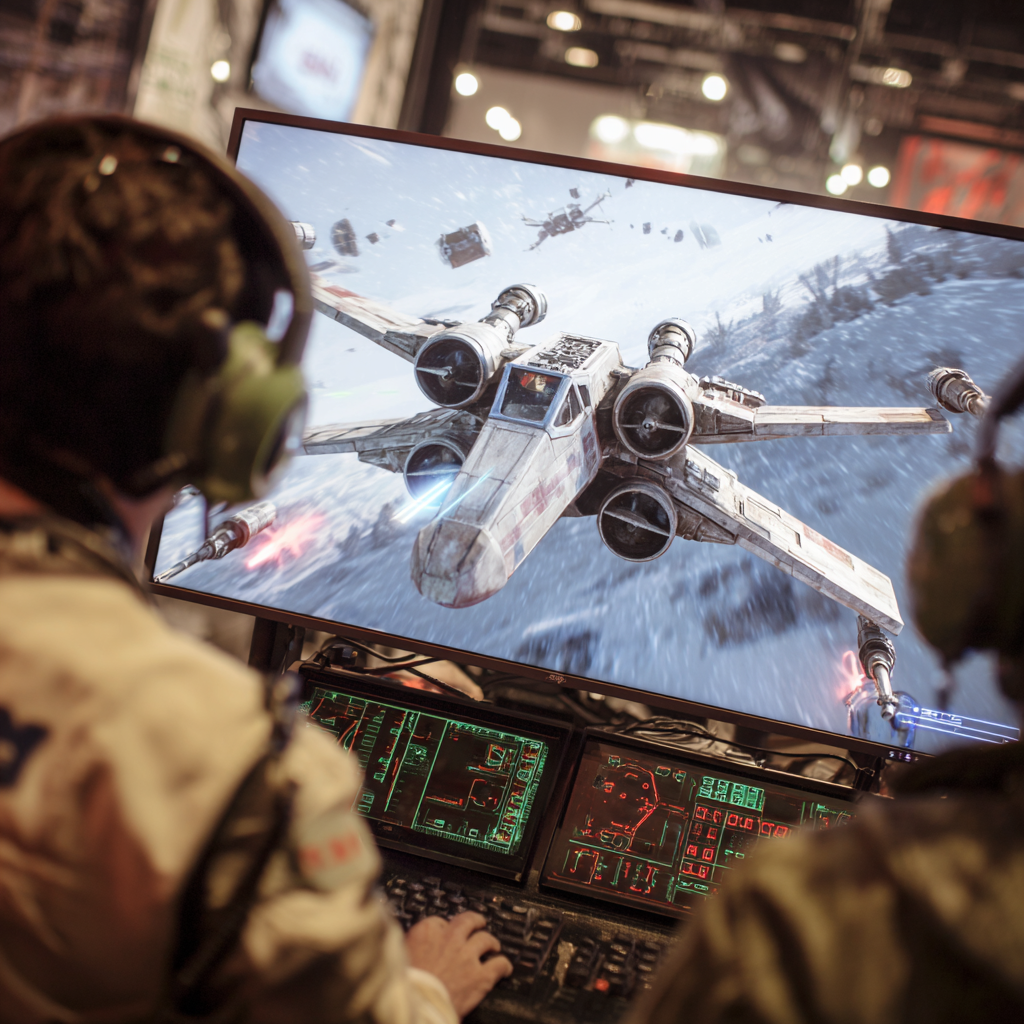
Quick Answers
● Game Title: Star Wars Racer Revenge
● Platform: PlayStation 2 (PS2)
● Release Era: 2002, early 3D console racing era
● Core Experience: High-speed podracing with arcade combat mechanics
● Universe Placement: Post-The Phantom Menace Expanded Lore
● Why It Matters: One of the most aggressive, skill-driven Star Wars racing games ever made
Proof & Sources
- Wookieepedia: Star Wars Racer Revenge
What happens when Star Wars stops being about lightsabers and Force destiny—and becomes about raw speed, violence, and survival?
That question is exactly where Star Wars Racer Revenge lives.
Released quietly on PS2 and often overshadowed by larger Star Wars titles, Racer Revenge has aged into something unexpected: a cult classic that captures the galaxy's underbelly better than many story-driven games ever did. This is not a heroic tale of Jedi. It is a story of engines screaming, pilots cheating death, and victory earned through brutality rather than prophecy.
This article explains what Star Wars Racer Revenge really is, how it differs from other podracing games, why it still resonates with players today, and how it fits into the broader Star Wars universe.
From Podracing Spectacle to Violent Sport
Podracing debuted in The Phantom Menace as spectacle—dangerous, illegal, thrilling, but still presented with cinematic wonder. In Star Wars Episode I: Racer, that sense of spectacle dominated the design philosophy.
Star Wars Racer Revenge takes a different stance.
Here, podracing is no longer entertainment. It is a war on engines.
The game positions itself after the events of Episode I, in a galaxy where podracing has evolved into a more ruthless sport. Tracks are narrower, collisions are deadlier, and opponents are not merely rivals—they are threats to eliminate.
This tonal shift is critical to understanding why Racer Revenge feels so different. It leans into the idea that in a galaxy ruled by empires and crime syndicates, even sport becomes predatory.
Read more: Everything We Know About Skeleton Crew's Connection to the Jedi Order
Sebulba's Return and the Idea of "Revenge"
At the heart of the game is Sebulba, the infamous Dug podracer defeated by Anakin Skywalker. His return is not framed as nostalgia—it is framed as obsession.
Sebulba's loss represents humiliation in a culture built on dominance. Racer Revenge treats that loss as a wound that never healed. The game's tone, track design, and combat mechanics all reinforce this idea: racers are not trying to win honor—they are trying to erase weakness.
This is why the game introduces more direct combat elements. Boosts are weapons. Collisions are strategies. Track hazards are tools to exploit, not obstacles to avoid.
The title "Revenge" is not metaphorical. It is thematic.
Why Star Wars Racer Revenge Feels Faster Than It Looks
One of the most striking things about Star Wars Racer Revenge gameplay is the illusion of speed. Even compared to modern racers, the sense of velocity feels aggressive and unstable.
This is achieved through several deliberate design choices. The camera sits low and close to the engines, making the terrain rush toward the player. Tracks are filled with sudden elevation changes, sharp turns, and environmental threats that punish hesitation.
Unlike simulation racers, Racer Revenge encourages risk. The fastest routes are often the most dangerous, and mastering the boost system means learning when to sacrifice control for momentum.
This design philosophy aligns with Star Wars' portrayal of fringe technology: powerful, unstable, and barely under control.
Racing Without Heroes: A Star Wars Outlier
Star Wars usually frames conflict in moral terms. Light versus dark. Hope versus fear.
Racer Revenge removes that framework entirely.
There are no heroes here. No chosen ones. No redemptive arcs. Every racer exists in the same moral gray space—motivated by credits, pride, or survival. This makes the game one of the rare Star Wars experiences that focuses entirely on the galaxy's lower strata.
In doing so, it unintentionally becomes one of the most authentic portrayals of Star Wars' criminal ecosystem. This is the same world that produces bounty hunters, smugglers, and underground arenas. Racer Revenge shifts the lens.
Tracks as Storytelling Devices
Each track in *Star Wars Racer Revenge PS2* feels hostile by design. Industrial zones crush careless racers. Desert tracks strip away visibility and control. Urban environments funnel players into chaotic chokepoints.
These environments tell a story without dialogue. They suggest planets exploited for profit, arenas built without regard for safety, and races designed for spectacle rather than fairness.
This environmental storytelling aligns with broader Star Wars lore, in which progress often comes at the expense of lives on the margins. Racer Revenge doesn't explain this explicitly—it lets players feel it.
How Racer Revenge Differs From Episode I: Racer
While often compared, these two games represent very different philosophies.
Episode I: Racer emphasizes mastery of physics, repair management, and long-form endurance. Racer Revenge emphasizes aggression, speed, and confrontation. Where the former feels like professional racing, the latter feels like a street fight at 900 km/h.
This difference explains why Racer Revenge divided players at launch—and why it later gained appreciation. It is not a spirit sequel. It is a reinterpretation of podracing as a combat sport.
Why the PS2 Era Matters
The PS2 hardware allowed Racer Revenge to push effects, lighting, and particle systems beyond what was possible in earlier Star Wars racing games. Sparks, explosions, and environmental hazards all contribute to a sensory overload that reinforces a sense of danger.
Notably, the era's limitations also forced focus. Without modern cinematic tools, the game relies on feel rather than exposition. Speed, sound, and reaction time become the narrative.
This is why Star Wars Racer Revenge gameplay still feels intense decades later.
👉 Explore more lightsabers here.
Racer Revenge as Expanded Star Wars Lore
Though not a narrative-heavy title, Racer Revenge expands the Star Wars universe by showing what happens after cinematic moments fade. Anakin leaves Tatooine—the Jedi rise and fall. But the races continue.
This perspective grounds the galaxy. It reminds players that most beings in Star Wars never come into contact with the Force. They race, gamble, cheat, and die in arenas forgotten by history.
That makes Racer Revenge quietly profound.
Why Racer Revenge Still Has a Cult Following
Modern players returning to Racer Revenge often describe the same feeling: surprise. The game is more complex, faster, and more punishing than expected. It demands focus rather than casual play.
In an era of forgiving racing games, Racer Revenge feels almost confrontational. That friction is precisely why it remains memorable.
It respects the player's skill and punishes complacency—values that align with classic arcade philosophy.
Learn more: These Are The Coolest Speeders From The Star Wars Universe
Why Star Wars Racer Revenge Still Matters Today
Racer Revenge matters because it proves Star Wars can thrive outside its usual mythic structure. It shows that the galaxy is big enough for stories about engines, obsession, and survival without destiny.
In doing so, it expands what Star Wars can be—not just a saga of heroes, but a universe of consequences.
FAQs
What is Star Wars Racer Revenge?
A PS2 racing game focused on high-speed podracing with aggressive combat mechanics set after The Phantom Menace.
Is Star Wars Racer Revenge a sequel?
Not directly. It reimagines podracing with a darker, more violent tone rather than continuing Episode I: Racer's systems.
Why is Sebulba important in the game?
He represents obsession with dominance and the idea of reclaiming lost power after defeat.
Is Racer Revenge considered canon?
It exists within Star Wars Legends-era expanded material rather than the current canon.
Why does the gameplay feel so intense?
Track design, camera placement, and combat-oriented mechanics amplify speed and danger.
Is the game challenging?
Yes. It rewards mastery and punishes mistakes, making it more demanding than many modern racers.
Does the game tell a story?
Indirectly. The story is conveyed through tone, environments, and mechanics rather than dialogue.
Why do fans still talk about it?
Its unique blend of speed, aggression, and atmosphere makes it stand out among Star Wars games.
Can modern players still enjoy it?
Absolutely, especially those who enjoy skill-based arcade racers.
How does it expand Star Wars lore?
By focusing on the galaxy's underground culture rather than Force-driven narratives.
Join the Nsabers Community
Explore every corner of the Star Wars universe—from ancient legends to forgotten races that burned brighter than any lightsaber.
✨ Follow Nsabers across the galaxy:
💬 We'd love to hear from you!
Did you play Star Wars Racer Revenge on PS2? Share your favorite tracks, memories, or high-speed moments with the community.

Deixar comentário
Os comentários precisam ser aprovados antes da publicação.
Este site é protegido por hCaptcha e a Política de privacidade e os Termos de serviço do hCaptcha se aplicam.