
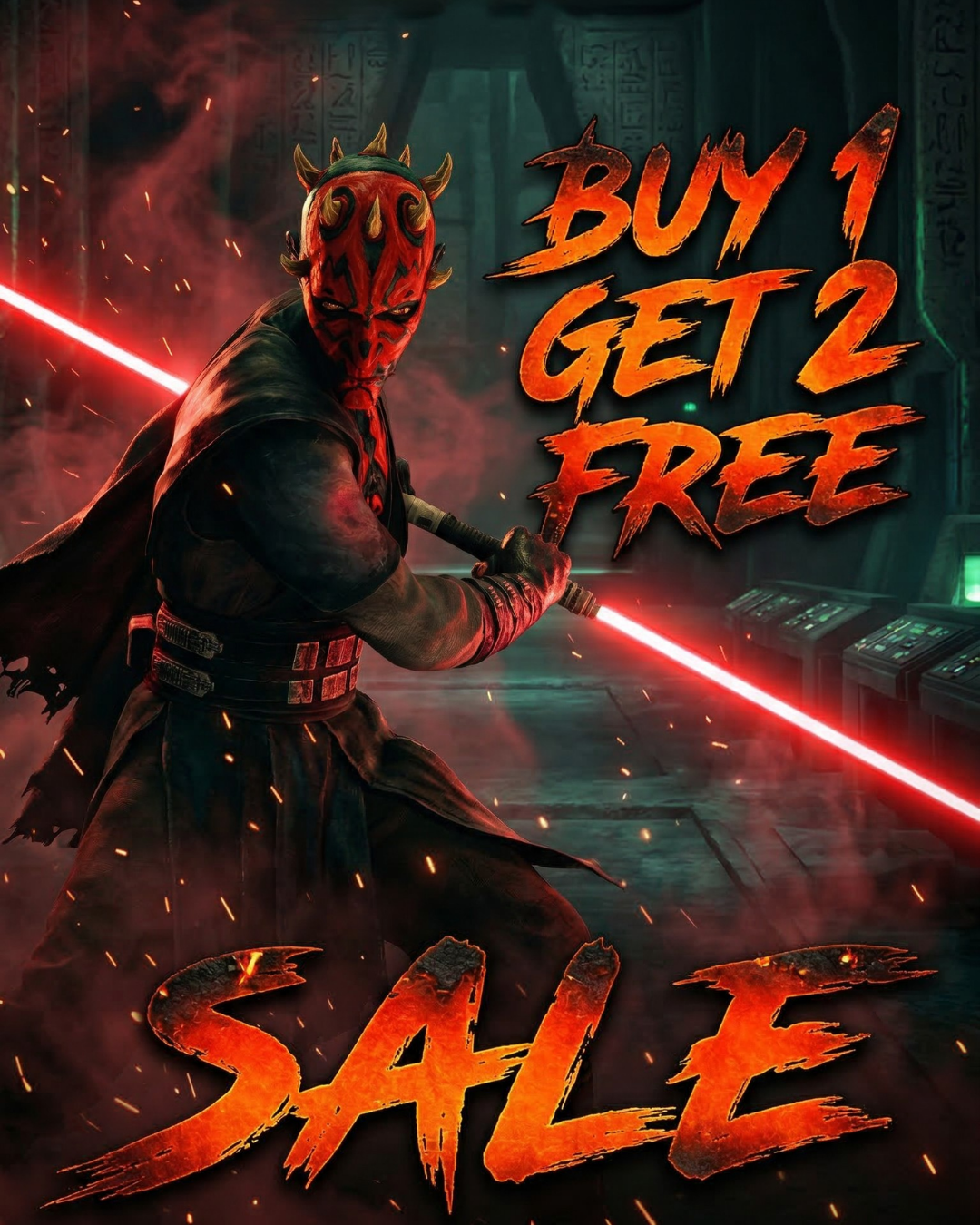

Have you ever looked at a Shadow Maul lightsaber and felt like you were holding more than a weapon—like it’s a symbol of the exact moment Maul stops being someone else’s blade and starts becoming the shadow that moves entire systems?
If you’re here as a fan, you already know the truth: Maul’s story isn’t only about rage or revenge, and his saber isn’t only about combat. The double-bladed design is iconic on sight, but what makes it unforgettable is what it represents across different eras—fear when he’s unleashed, authority when he builds power, and controlled menace when he rebuilds in the Empire’s shadow.
If you like collector-grade replicas and story-first builds, you can browse the premium hub here: Master Series lightsabers.
If you want the featured centerpiece from this post, you can see it here: Maul – Watto’s Junkyard Design.
Quick Answers for Fans
The Shadow Maul lightsaber vibe fits best in the period after the Clone Wars, when Maul is no longer playing the old Sith hierarchy and instead rebuilds influence as an underworld power broker, shaping outcomes through fear, alliances, and quiet leverage rather than banners and armies. In Star Wars: Maul – Shadow Lord, the premise places Maul around a year after the Clone Wars, rebuilding a criminal syndicate and seeking a new apprentice on the planet Janix during the reign of the Galactic Empire, which gives fans a fresh, focused lens on Maul as a builder of shadow power rather than merely a combat threat.
The weapon anchor remains the same silhouette that changed Star Wars dueling forever: Maul’s double-bladed saber. In Darth Maul’s Lightsaber, the description notes the weapon is made by joining two hilts end-to-end, and highlights Maul’s ability to wield it as a single-bladed saber or ignite both crimson blades to fight multiple opponents, which is a perfect metaphor for how Maul presents himself—sometimes restrained and surgical, sometimes overwhelming and unavoidable.
The “Shadow” in Shadow Maul isn’t a mood, it’s a method
People call him “Shadow Maul” because the character evolves from a terrifying enforcer into something more unsettling: an architect of underworld power. In his earliest appearance, Maul is introduced with the energy of a weapon that has been pointed at a target and released—silent, precise, and terrifying because his purpose seems singular and unstoppable. As his story expands, the fear changes shape, because Maul becomes less about a single strike and more about the system behind the strike, the network that makes violence feel inevitable before it even arrives.
That’s why the Shadow Maul lightsaber feels meaningfully different from “Episode I Maul,” even though the silhouette is instantly recognizable. In a duel, the saber is a tool; in a syndicate world, the saber is a signature. It becomes the object that says, “This isn’t a conversation,” and it says it without needing a speech, because shadow power doesn’t require ceremony to be effective. Shadow power works through pressure points—routes, debts, fear, and alliances that can’t be written down—and Maul’s presence belongs naturally in that ecosystem because he understands that control is often more valuable than conquest.
The double blade as a signature of inevitability
The double-bladed saber doesn’t just look distinctive; it changes the way you read a scene before anyone moves, because it transforms a lightsaber into a boundary line. In the Databank description, Maul’s weapon is described as made by joining two hilts end-to-end, which gives it the feel of a deliberate construction rather than a flashy gimmick, and that detail makes the saber feel more like a tool engineered for dominance than an ornament built for attention.
What truly elevates the design is that Maul can present different “faces” of threat with the same weapon, since the Databank notes he can use it as a single-bladed saber or ignite both blades to fight multiple opponents, letting the saber communicate whether he’s warning a room or closing it. A single blade suggests control and precision, while a double blade suggests that the space itself has become hostile, because there is no safe angle left. When fans talk about a Shadow Maul lightsaber, they’re often talking about that psychological effect—the feeling that you’re not just being challenged, you’re being surrounded.
Shadow Collective: where Maul stops being a blade and becomes a banner
If you want the cleanest lore anchor for the “Shadow Maul” identity, it’s the Shadow Collective, because it shows Maul building power through the underworld rather than merely fighting for someone else’s agenda. In Shadow Collective, it’s described as an alliance of underworld organizations assembled by Maul through a mix of persuasion and brute force, including a deal with Death Watch leader Pre Vizsla, support from the Pyke Syndicate, and forced subjugation of Black Sun and the Hutt Clan, which reads like a blueprint for how Maul’s shadow-rule works: charm when it wins, violence when it doesn’t, and relentless focus on building a machine that can move fear like currency.
The entry also notes that the Collective takes over Mandalore and then fractures after Maul’s defeat by Sidious, and that rise-and-collapse arc matters because Maul’s story is haunted by the psychology of building power and losing it. Once you’ve constructed a system and watched it collapse, you don’t become softer—you become more surgical, more suspicious, and more committed to control through shadows rather than declarations. That’s where the Shadow Maul lightsaber becomes more than a combat tool, because it starts functioning like an insignia: the symbol that tells everyone in the room who owns the outcome, even if nobody says it out loud.
Enter “Shadow Lord”: Maul in the Empire’s shadow
Fans have felt the “Shadow Maul” era for a long time, but Maul – Shadow Lord gives that feeling a focused spotlight by framing Maul in the years after the Clone Wars, when the galaxy is reshaped under the Empire and the old rules no longer apply. The premise describes Maul rebuilding a criminal syndicate and seeking a new apprentice on Janix during the reign of the Galactic Empire, which places Maul in the perfect narrative position for shadow power: he isn’t a public leader, he isn’t a ceremonial Sith, and he isn’t a simple fugitive either—he’s a figure building influence in the spaces the Empire doesn’t fully control.
The production overview notes the story is serialized and explores questions about Maul discussed during prior work, and it describes an animation approach that is similar to The Clone Wars but more stylized to reflect Maul and the setting of Janix, which is a subtle but meaningful clue that “Shadow Lord Maul” is meant to feel like a distinct chapter rather than a simple continuation. Whether you’re a lore-first fan or a visual-first fan, that matters, because Maul has always been a character where atmosphere does half the storytelling, and a stylized, underworld setting naturally amplifies the “Shadow Maul” identity.
Janix: Why does a new world changes how the saber feels
Star Wars worlds are emotional shortcuts, because a single planet name can carry a whole mood: Tatooine feels dusty and fatalistic, Coruscant feels crowded and political, and Mandalore feels armored and proud. Janix is exciting precisely because it’s new enough to be unknown, and that unknown quality suits Maul, because Maul thrives in spaces where rules aren’t enforced evenly and where fear can be leveraged quietly.
In the Shadow Lord framing, Janix gives the Shadow Maul lightsaber a stage that doesn’t arrive with prebuilt expectations, which means fans can imagine it as an artifact of a new underworld ecosystem—something carried in back rooms, hidden corridors, and meetings where nobody trusts anyone, and where a single ignition can end a negotiation without a word. When you imagine Maul rebuilding in a place the Empire doesn’t fully “own,” the saber stops feeling like a relic of an older Sith war and starts feeling like a living tool of present control, which is the heart of the Shadow Maul fantasy.
The Shadow Maul lightsaber as a story object, not just a weapon
A lightsaber always carries a kind of mythology, but Maul’s double blade carries something more specific: inevitability. It’s a design that dominates space, and it communicates threat even at rest, because your eyes read “two ends” and your brain reads “no safe angle.” That’s why the Shadow Maul lightsaber works so well for collectors and cosplayers; even if you never duel, the object carries motion inside it, and even if you never spin it, the silhouette tells a story.
In practical terms, this is also why “Shadow Maul” looks best when it’s displayed or filmed with restraint, because Maul’s most intimidating moments are not always the fastest ones; they’re the moments where control is absolute and movement is deliberate. Shadow Maul isn’t “chaos,” and it isn’t “flash,” and it isn’t “random violence.” Shadow Maul is the stillness that makes violence feel certain, and the saber is the clearest physical symbol of that certainty.
Featured centerpiece: Maul – Watto’s Junkyard Design (Nsabers)
If you want a real-world centerpiece that matches Shadow Maul energy—collector-forward, display-worthy, and built to feel like an artifact rather than a toy—this is the featured piece in this post: Maul – Watto’s Junkyard Design. The listing frames it as a limited collaboration piece and emphasizes “crafted for collectors,” which matters because the Shadow Maul fantasy is not “common weapon,” it’s “rare artifact,” the kind of object you imagine locked behind glass in a syndicate vault.
The product page highlights a hand-numbered series and states “One of 300 Worldwide,” which fits the idea of a Shadow Lord trophy—scarce, personalized, and treated like evidence rather than decoration. That collector framing pairs naturally with Maul’s underworld era, because shadow power is always about exclusivity: who gets access, who gets protection, who gets information, and who doesn’t. When a piece is numbered, it feels like it belongs to that world, because it becomes part of a smaller circle.

The aura of Shadow Maul: control, pressure, and inevitability
Maul’s combat identity is famous, but Shadow Maul is not only about combat; it’s about how combat becomes politics. In the Databank description of Maul’s double-bladed saber, it highlights that Maul’s dexterity and training allow him to fight with one blade or two and to take on multiple opponents, which is a neat summary of Maul’s broader identity: he is adaptable, he is relentless, and he turns space itself into pressure.
In the underworld, that translates into a specific kind of fear, because fear is more valuable when it’s predictable. Shadow Maul isn’t frightening because he might do something; he’s frightening because the room can already feel what the outcome is. That’s why the Shadow Maul lightsaber works so well as an icon: it’s not a symbol of ideology or ceremony, it’s a symbol of inevitability. It’s the warning on the wall, the signature on the threat, and the quiet proof that Maul doesn’t need permission to act.
Three display stories that make Shadow Maul feel real
A Shadow Maul display is at its best when it has a coherent story, because Maul’s presence has always been coherent: it’s controlled, deliberate, and built to unsettle. One approach is the “Shadow Collective vault” story, where the saber rests against a matte black backdrop with low red underglow, making it feel like a trophy of underworld rule rather than a museum piece. Another approach is “Janix noir,” where you use a single warm key light, heavy shadows, and subtle dust or fog texture to make the hilt look like an artifact discovered in a dangerous place rather than purchased in a safe one. A third approach is “Mandalore trophy,” where industrial textures and cool steel tones dominate the scene and the red accent feels like a warning light in a conquered space.
The common thread is restraint. Shadow Maul doesn’t need a loud shelf, because Maul is loud enough on his own. When the environment is quiet, the Shadow Maul lightsaber becomes the authority in the frame, and that authority is what fans feel when they think about Maul’s underworld era.
The underworld doesn’t worship the Force, but it fears it
One of the reasons Maul fits the underworld so well is that criminal ecosystems don’t care about Jedi philosophy or Sith doctrine; they care about certainty, advantage, and survival. A lightsaber is certainty, because it doesn’t need a supply chain and it doesn’t ask permission, and Maul’s double blade is certainty with teeth because it reads like dominance before it even moves.
That’s why the Shadow Maul lightsaber stands apart from many Sith replicas in fan imagination. Some Sith weapons feel ceremonial, like symbols of a rigid ideology; Maul’s feels like a tool used by someone who understands fear as currency. It belongs in back rooms and shadow corridors, in meetings where everyone is lying and the only honest object is the weapon that can end the lie instantly.

Read more
If you want a deeper dive that pairs well with this theme and keeps the lore conversation going, you can include this internal guide as a “keep reading” moment: History of the Double-Bladed Lightsaber.
FAQ
1) What does “Shadow Maul” mean to fans?
To fans, “Shadow Maul” is the version of Maul defined by underworld power rather than open war, where his influence spreads through alliances, intimidation, and quiet leverage, and where the saber becomes less of a dueling prop and more of a signature of authority that can end a negotiation without a word. The Shadow Collective concept captures this perfectly, since it’s described as an alliance of underworld organizations Maul assembles using persuasion and brute force, turning criminal networks into a weaponized system.
2) Why is the Shadow Collective so important to the Shadow Maul era?
The Shadow Collective matters because it shows Maul as a builder of power structures rather than merely a combatant, and it ties his identity to the underworld logic of deals, fear, and forced loyalty. The Databank description emphasizes that Maul gains support from some groups and subjugates others by force, and that the Collective takes over Mandalore before fracturing after Maul’s defeat by Sidious, which frames the Shadow Maul era as a rise built on control and an aftermath shaped by loss.
3) What makes Maul’s double-bladed saber different from most lightsabers?
Maul’s saber is described as a double-bladed weapon created by joining two hilts end-to-end, which makes it feel engineered for dominance rather than styled for elegance, and the Databank highlights that Maul can wield it as a single-bladed saber or ignite both crimson blades to fight multiple opponents. That combination of construction and versatility is why the silhouette communicates threat even at rest and why it became a cultural icon for aggressive, space-controlling combat.
4) Did Maul really switch between one blade and two blades in canon descriptions?
Yes, the Databank description explicitly notes that Maul’s training allows him to use the weapon as a single-bladed saber or activate both crimson blades, which reinforces the idea that the saber can communicate different “modes” of threat—restraint and precision when one blade is active, and overwhelming domination when both are lit. This flexibility is part of why the weapon feels tactical rather than purely theatrical.
5) What does Maul – Shadow Lord add to the Shadow Maul feeling?
The premise places Maul around a year after the Clone Wars as he rebuilds a criminal syndicate and seeks a new apprentice on Janix during the reign of the Empire, which frames Maul as a self-directed power broker operating inside a newly reshaped galaxy where public authority is tightening and underworld space becomes even more valuable. It turns “Shadow Maul” into a focused chapter where rebuilding and recruiting matter as much as fighting.
6) Why does Janix feel like a perfect setting for Shadow Maul energy?
Janix works as a Shadow Maul setting because it gives Maul a stage that feels unclaimed and unpredictable, which is where shadow power thrives; if Maul is rebuilding a criminal syndicate in a place the Empire doesn’t fully control, then the saber becomes an artifact of underworld survival rather than a symbol of formal Sith war. The premise explicitly ties Maul’s rebuilding efforts and apprentice search to Janix, which makes the planet name itself feel like part of the era’s atmosphere.
7) Why does the Shadow Maul lightsaber “feel” intimidating even when it’s off?
A double-bladed silhouette reads like space control, because it implies that danger can come from either end and that distance is less protective than it would be against a single blade. Since Maul’s weapon is described as usable with one blade or two, the saber can suggest different levels of threat even in imagination, and that psychological flexibility is what makes it feel like authority rather than mere decoration. The intimidation is baked into the geometry.
8) If I’m a cosplayer, how do I make Shadow Maul feel authentic without overdoing it?
Shadow Maul looks most authentic when the performance is controlled rather than chaotic, because underworld power is about inevitability, not noise; a calm stance, deliberate ignition timing, and a single red accent light can communicate Shadow Lord energy more effectively than nonstop spinning. When you treat the saber like a signature rather than a toy, the whole character reads as someone who rules quietly until violence becomes necessary, which is the heart of the Shadow Maul fantasy.
9) What makes a Shadow Maul display feel “canon-friendly” as a fan shelf?
A canon-friendly Shadow Maul shelf is less about perfectly copying one scene and more about honoring the era’s mood: low light, strong silhouette, and a sense that the saber belongs to an underworld story rather than a ceremonial hall. The Shadow Collective framing is useful because it ties Maul to syndicate alliances and takeover ambitions, so industrial textures, vault-like backdrops, and controlled red underglow can make the saber feel like a trophy of shadow rule rather than a museum artifact.
10) Where can I find a collector centerpiece that matches the Shadow Maul vibe?
If you want a collector centerpiece that leans into the Shadow Maul feeling with “artifact” energy, the featured piece in this post is Maul – Watto’s Junkyard Design, which is framed as a limited collector collaboration and includes a hand-numbered series described as one of 300 worldwide, making it feel like the kind of rare object you’d imagine locked behind glass in a syndicate vault. You can view it here: https://nsabers.com/products/maul-watto-s-junkyard-design
Join the community
If you’re building a Shadow Maul lightsaber shelf or cosplay, share your theme in the comments—“Shadow Collective vault,” “Janix noir,” or “Mandalore trophy”—and tell people whether you prefer the story of restraint (single blade) or inevitability (double blade) when you imagine Maul walking into a room.
✨ Follow Nsabers across the galaxy:
💬 We’d love to hear from you!


Leave a comment
This site is protected by hCaptcha and the hCaptcha Privacy Policy and Terms of Service apply.