

Quick Answers
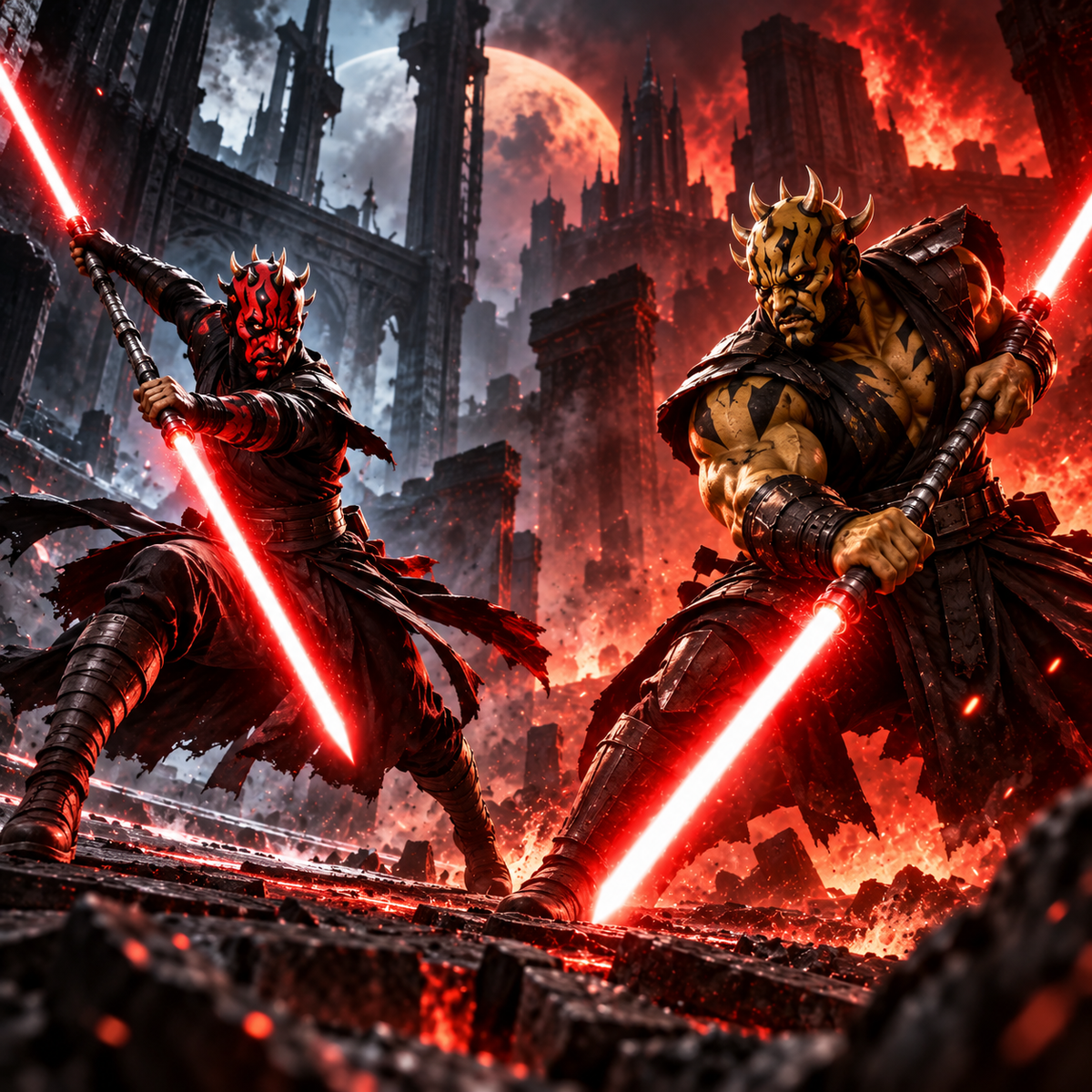
- The Savage Opress vs Maul lightsaber comparison starts with a major similarity: both characters are strongly associated with double-bladed red saberstaffs, but they use them in noticeably different ways.
- Darth Maul's saberstaff supports speed, precision, rotational control, feints, kicks, and rapid angle changes, reflecting his deeper combat training.
- Savage Opress uses his double-bladed weapon more like an amplifier for physical power, relying on heavy strikes, broad attacks, forward pressure, and control of the space around him.
- Their weapons also create different visual impressions. Maul's iconic saberstaff looks streamlined and balanced for fluid staff movement, while Savage's weapon complements his larger frame and more forceful silhouette.
- Neither double-bladed lightsaber is automatically "better." Maul generally demonstrates greater technical mastery, while Savage gains exceptional value from leverage, reach, strength, and intimidation.
- When discussing Sith saber styles, it is safer to compare what the characters actually do on screen than to force every movement into a numbered lightsaber form that current canon doesn't always explicitly confirm.
Proof & Sources
The clearest comparison comes from the characters' appearances in The Phantom Menace and Star Wars: The Clone Wars, where viewers can directly observe their weapons, movement, training, and battles. Official Star Wars character material provides additional context for both brothers and their relationship with the dark side.
If Savage Opress and Darth Maul both wield double-bladed red lightsabers, why do their weapons feel so different the moment each brother starts fighting?
Their lightsabers look similar because the brothers are meant to feel connected.
At first glance, the Savage Opress vs Maul lightsaber comparison seems simple. Both characters are horned Zabrak dark-side warriors, both are associated with long double-bladed hilts, and both ignite red blades from opposite ends of the weapon. When they appear together in The Clone Wars, that shared visual language immediately makes them look like a pair. Before either brother attacks, their silhouettes already communicate family connection, shared aggression, and separation from the Jedi around them.
That similarity is important because Star Wars often uses weapon design as character shorthand. A curved hilt suggests Count Dooku before he even moves, the Darksaber carries Mandalorian history before a duel begins, and Maul's red saberstaff became inseparable from his identity after The Phantom Menace. Giving Savage another double-bladed red weapon connects him visually to his brother, but the comparison becomes much more interesting once the two start using their sabers differently.
The weapons therefore should not be read as identical copies. They belong to the same broad saberstaff family, yet each one works with a different body, training history, and combat philosophy. Maul makes the weapon look precise, almost surgical, despite its size. Savage makes a similar configuration feel heavy, brutal, and physically overwhelming. The hardware creates the connection, while the choreography establishes the difference.
Darth Maul's saberstaff is built around control.
Maul's original double-bladed lightsaber became famous because it did more than add another blade. In his hands, the long hilt becomes the central axis of an entire movement system. Maul rotates it through grip changes, shifts the weapon between sides of his body, attacks from unexpected angles, and combines blade work with kicks and full-body movement. The second blade is integrated into the rhythm rather than treated as an extra attachment.
That is the key to Maul's effectiveness. He rarely looks like he is fighting the weapon's size. The saberstaff follows his motion naturally, and his body often moves before the audience can clearly identify which blade will become the immediate threat. One end may intercept an attack while the other shifts into position for the next strike, making defense and offense seem almost continuous.
This level of control reflects Maul's background. Darth Sidious trained him extensively and shaped him from an early age into a dangerous Sith combatant. Whatever terminology describes his fighting system, his on-screen behavior shows a deep understanding of distance, timing, body mechanics, and how to exploit the unusual geometry of a double-bladed weapon.
Read more: Does Darth Maul's Lightsaber have Two Kyber Crystals?
Savage Opress turns the saberstaff into a weapon of physical pressure.
Savage's combat produces a very different impression. His enormous physical frame naturally changes how a double-bladed lightsaber reads on screen. Where Maul often uses rotation to create angles, Savage frequently uses the weapon to make every contact feel physically punishing. His swings cover wide areas, his forward movement forces opponents to give ground, and his strength makes even a successful block look uncomfortable.
This does not mean Savage swings without technique. A saberstaff is far too dangerous to use carelessly, especially when a live blade extends behind the user during many movements. Savage must stay aware of both ends, control the long central grip, and understand how rotation changes the second blade's position. His ability to fight effectively with the weapon already demonstrates significant training.
The difference lies in emphasis. Savage tends to solve problems through pressure. When an opponent blocks, he can continue driving through the exchange. When several enemies occupy the space around him, broad attacks allow him to threaten multiple directions. His Savage Opress weapon effectively multiplies the value of traits he already possesses: exceptional size, strength, aggression, reach, and willingness to enter close-range violence.
Training history explains much of the difference.
Maul and Savage are brothers, but their development as fighters differs radically. Maul spent years under Darth Sidious and was shaped specifically to become a deadly Sith warrior. His training included far more than learning how to activate a lightsaber. He was conditioned to fight Jedi, weaponize his emotions, combine physical techniques with the Force, and survive against highly skilled opponents.
Savage receives a much more accelerated education. After the Nightsisters transform him, Count Dooku takes him on as a dark-side apprentice. Savage has enormous potential, but the training immediately reveals how different potential is from mastery. Dooku can exploit his technical mistakes, punish emotional overcommitment, and demonstrate that physical power cannot replace years of refined practice.
Later, Maul becomes another major influence on Savage. Fighting beside his brother improves Savage's effectiveness and gives him experience against increasingly dangerous opponents. Even so, the difference in their foundations remains visible. Maul looks like a trained specialist who happens to be physically dangerous. Savage looks like an extraordinarily dangerous physical fighter whose technical education is still catching up with his power.
Their hilts create different visual impressions.
Both sabers fall into the same general category, but their hilts convey different personalities. Maul's iconic saberstaff has a relatively streamlined, elongated profile that suggests symmetry and rotational control. The design visually encourages the eye to follow the weapon around a central axis, reinforcing the fluidity that defines many of his most famous fights.
Savage's double-bladed lightsaber appears more at home beside his heavier physical design. Rather than disappearing into rapid movement, the weapon often feels like a large object being driven through space by an equally large fighter. Even without relying on exact dimensions or fictional engineering specifications, the difference in silhouette and screen presentation is noticeable.
This matters because Star Wars weapons are rarely neutral props. Their appearance usually reinforces the owner. Maul's saberstaff complements a warrior whose danger comes from speed, precision, and technical unpredictability. Savage's complements someone who wants the opponent to feel that every defensive mistake could lead to overwhelming physical punishment.
The most useful comparison, therefore, is not which hilt "looks stronger." It is how effectively each design supports the way its owner is presented.
Maul uses both blades to create uncertainty.
A double-bladed lightsaber creates a unique problem for the opponent: blocking one end does not neutralize the entire weapon. Maul exploits this more deliberately than Savage. He can rotate the central grip so a defensive movement naturally sets up the opposite blade for an attack, forcing the other fighter to process multiple threats in one continuous motion.
His footwork reinforces that uncertainty. Maul changes angles around the opponent instead of always remaining directly in front. That means the second blade can suddenly become relevant from a direction the defender was not originally monitoring. The weapon is dangerous not simply because it has two ends, but because Maul constantly changes which end matters.
This helps explain the saberstaff's effectiveness during the duel with Qui-Gon Jinn and Obi-Wan Kenobi. Fighting two Jedi requires more than swinging widely. Maul must control where each opponent can stand, prevent them from attacking simultaneously at their best angles, and shift attention between them without losing control of his own weapon.
The second blade becomes part of a spatial problem Maul continuously presents to his opponents.
Savage uses both blades to control territory
Savage's version of space control looks different. Rather than constantly creating subtle uncertainty, he often makes particular areas physically dangerous to enter. A broad saberstaff rotation combined with his reach can force multiple opponents to hesitate before closing distance.
This is especially valuable because his physical presence already influences positioning. Fighting Savage at close range means dealing not only with his lightsaber but also with his body, horns, kicks, Force abilities, and ability to turn physical contact into an advantage. The double-bladed weapon expands that danger outward.
In this context, the second blade functions almost like a moving barrier. An opponent trying to move around Savage must account for the opposite end sweeping through the space behind or beside him. Even if Savage is attacking someone directly in front, the weapon can discourage another enemy from approaching from a different direction.
That makes his saberstaff particularly effective in chaotic fights. Savage does not need to turn every exchange into elegant fencing. He can make the surrounding space unpleasant enough that opponents are forced to fight on his terms.
Their body mechanics are almost opposite.
Maul frequently uses flexibility and rotation. His torso turns, his stance changes, his legs become active offensive tools, and the saberstaff moves around several axes. The weapon is integrated into an athletic system where the body and blades constantly exchange momentum.
Savage relies more heavily on leverage. His large frame lets him grip the longer hilt with both hands and generate Force through his shoulders, torso, and arms. A strike doesn't need a complex angle if it's powerful enough to compromise the opponent's balance.
These approaches reveal why comparing only the weapons gives an incomplete answer. If the brothers exchanged identical saberstaffs, their combat would still look very different because the user is the main difference.
Maul turns a long double-bladed weapon into something fast.
Savage turns it into something heavy.
That contrast is the most important part of any double-bladed lightsaber comparison between the two characters.
Maul combines the saberstaff with kicks more naturally.
One of Maul's signature qualities is how seamlessly he mixes unarmed movement with lightsaber combat. Kicks are not pauses between saber exchanges; they are integrated into combinations. Maul's leg can suddenly strike an opponent watching the two red blades because the weapon has occupied so much visual and defensive attention.
This creates another layer of unpredictability. Defending a saberstaff already requires awareness of two dangerous ends. Maul then adds attacks that do not come from the saber at all. The weapon becomes as much a distraction and positional tool as a cutting instrument.
His famous duel on Naboo demonstrates this repeatedly. Maul doesn't behave like someone whose entire fighting identity lives inside the hilt. He uses distance, body positioning, strikes, and environmental movement together.
Savage can also use his body aggressively, but the effect differs. When Savage incorporates physical attacks, they tend to reinforce his strength and brutality rather than Maul's speed and deceptive rhythm. The brothers arrive at mixed weapon-and-body combat through different paths.
Savage's physical attacks are harder to ignore
Savage's body is a major tactical problem. A Jedi cannot simply focus on blade alignment while standing close enough to be struck, thrown, driven backward, or hit by Savage's horns. His lightsaber fighting therefore becomes part of a larger close-combat threat.
This is especially visible in battles where Savage closes distance aggressively. The saberstaff creates the opening, but the final advantage may come from direct physical Force rather than a perfect blade sequence. That makes him less predictable than a description such as "poorly trained swordsman" would suggest.
Technical refinement still matters, but Savage can break conventional rhythms because his strength gives him options many fighters do not possess. A blocked strike can turn into a physical contest. A close engagement can become a grapple-like collision. A moment that would normally reset the duel can instead let Savage keep pushing forward.
His saberstaff is therefore best understood as one part of a complete aggressive system rather than the only source of danger.
Both use red blades, but the color tells us less about their differences.
There is essentially no meaningful contrast between the brothers in terms of saber color. Both are associated with red blades, visually placing them within the dark side and Sith tradition surrounding their stories.
In current canon, red lightsaber crystals are associated with kyber bleeding through the dark side. That broader lore explains why red becomes such an immediate visual signifier for Sith-associated characters. However, the exact step-by-step history of every individual crystal Maul or Savage uses isn't always shown directly on screen.
For this comparison, color therefore tells us what the brothers share rather than what separates them. Both communicate danger, dark-side allegiance, and opposition to the Jedi through red blades.
The real differences emerge from hilt design, training, movement, tactical preferences, and the level of control each fighter demonstrates.
Maul is more comfortable shifting the rhythm of a duel.
Maul's experience allows him to vary tempo more effectively. He can attack in rapid sequences, pause long enough to provoke a reaction, then suddenly change direction or range. This prevents opponents from settling into a predictable defensive pattern.
The saberstaff helps because the weapon can remain threatening even during transitions. Maul doesn't always need to return to a neutral starting position before starting the next action. A rotation that appears to complete one exchange can set up another.
Savage is more likely to generate pressure by sustaining intensity. His rhythm often pushes the opponent to the breaking point. This can be highly effective, but it offers elite duelists more opportunities to study his commitment and wait for an opening.
This distinction becomes crucial against top-level opponents. Constant Force can dominate someone who can't withstand it; against a master who can survive the pressure, variation and tactical flexibility become increasingly important.
Read also: Star Wars: Every Maul Lightsaber Duel, Ranked
Their weapons behave differently against a single opponent.
Against one skilled opponent, Maul's strengths become particularly visible. He can use the two blades to manipulate the line of engagement, create feints, and force the defender to react to threats coming from opposite directions. The long hilt also gives him leverage without requiring every strike to become a power contest.
Savage can still be extremely dangerous one-on-one, especially if he establishes physical dominance. His preferred exchange often forces the opponent to choose between giving ground and taking the attack head-on. A weaker or less experienced fighter may be overwhelmed before technical differences become relevant.
The problem appears when the opponent refuses to fight Savage's fight. Someone with superior timing can avoid the strongest part of his attack, redirect his momentum, and strike during recovery. The bigger and more committed the movement, the more important recovery becomes.
Maul generally offers fewer obvious openings because he can shorten, redirect, or interrupt his movement more efficiently.
Against multiple opponents, both saberstaffs become especially useful.
The basic geometry of a double-bladed lightsaber makes sense against more than one attacker. Threats may come from opposite sides, and the second blade reduces the need to reverse the weapon every time the user changes direction fully.
Maul demonstrates this brilliantly against Qui-Gon and Obi-Wan. He uses footwork and positioning to keep the Jedi from exploiting their numerical advantage. When one approaches, the other must consider the opposite blade and Maul's ability to rotate his defense across both sides.
Savage benefits from the same basic geometry but uses it more aggressively. A wide attack can discourage several opponents from closing in at once, while his size gives those sweeping movements substantial reach.
Neither weapon eliminates the disadvantage of being outnumbered. Multiple coordinated opponents can still divide attention and attack from angles a single fighter cannot fully cover. The saberstaff gives both brothers better tools for managing that problem than many conventional single-bladed configurations.
Maul's saberstaff supports precision even when the fight looks chaotic.
One of the easiest mistakes when watching Maul is to confuse speed with randomness. His fights are visually busy, especially when the saberstaff rotates rapidly, but the best examples of his combat reveal controlled placement underneath the spectacle.
The blades move through precise areas relative to Maul's own body. He knows when to shorten the arc, when to extend, when to let the second end follow through, and when to disengage before the weapon's length becomes a disadvantage.
This is why his double-bladed weapon rarely appears to trap him. A less experienced fighter might over-rotate and find that the second blade limits the next movement. Maul generally uses that same second blade to create the next movement.
His mastery comes from understanding the relationship between both ends of the weapon rather than treating them independently.
Savage's saberstaff supports commitment.
Savage uses the long hilt differently. It allows him to commit both hands to an attack and transfer Force across a larger mechanical structure. The weapon becomes particularly threatening when he can drive directly through the opponent's defensive line.
That style can produce spectacular results because lightsaber combat isn't just about touching blades. Balance matters. Position matters. A fighter forced backward may lose the angle needed for a counterattack, even if they technically blocked the original strike.
Savage repeatedly tries to create exactly that situation. His goal is often not to win through the smallest possible opening but to make the opponent increasingly incapable of maintaining a stable defense.
The saberstaff therefore supports a philosophy of accumulation. One heavy attack may not end the fight, but repeated pressure can reduce space, disrupt footing, and eventually create an opening Savage can exploit.
Is Maul's lightsaber technically better?
Canon offers no useful basis for declaring one brother's saberstaff mechanically superior in every category. Star Wars rarely provides the kind of complete engineering specifications needed for a meaningful laboratory comparison of power output, material strength, efficiency, or other technical measurements.
We can confidently compare how effectively each weapon serves its user. Maul's saberstaff clearly supports his refined rotational style and advanced combat experience. Savage's weapon supports leverage, reach, broad attacks, and the physical pressure that defines his most successful exchanges.
If "better" means more effectively integrated with high-level technique, Maul demonstrates the stronger overall relationship between fighter and weapon. That conclusion, however, reflects Maul's mastery rather than proof that his hilt contains objectively superior technology.
A weapon in Star Wars is only as effective as the fighter who understands how to use its advantages while protecting its weaknesses.
Is Savage's saber more powerful?
Savage often makes his saber seem more powerful because of how he fights. The visual Force behind his attacks comes from the user, not necessarily from a blade producing more energy than Maul's.
This distinction matters. Two lightsabers can produce similarly lethal blades while feeling completely different in combat. If one fighter strikes with greater physical Force, the defender experiences more pressure through the bind even if the energy properties of the blades are comparable.
Savage's enormous strength creates exactly that effect. His weapon seems brutal because his entire body drives it.
Maul can generate Force when needed, but he more often prioritizes positioning and timing. His attacks don't need to look heavy if the blade finds an opening before the opponent can close it.
The contrast again shows why "power" is an ambiguous word in a lightsaber comparison.
Their greatest shared weakness is the long central hilt.
A saberstaff gains options from its length, but the same structure creates vulnerabilities. Both blades depend on a central assembly that must survive a close-quarters duel. Damage to that area can compromise the entire double-bladed configuration.
Maul's original weapon demonstrates the danger directly when Obi-Wan Kenobi cuts through the hilt during the Naboo duel. In one moment, the iconic saberstaff loses the configuration that had provided so much control against two Jedi.
A double-bladed fighter must therefore protect more than the active edges. The weapon's center becomes strategically important.
The long hilt can also create difficulties in extremely tight spaces. Large rotations become harder beside walls or obstacles, and an opponent who closes distance to the central grip may reduce some of the advantages the two blades provide.
Both brothers face these structural compromises regardless of their different styles.
Maul adapts better when the weapon stops being ideal.
The strongest evidence for Maul's superiority as a combatant is not simply how well he uses a saberstaff. It is how dangerous he remains when the fight changes.
After losing his original weapon, Maul continues to use different lightsabers and configurations in later stories. He can fight with a single blade, use other weapons, adapt to changed physical circumstances, and remain a serious threat to highly trained opponents.
This matters because true mastery cannot depend entirely on one piece of equipment. A fighter who is only dangerous with a particular hilt becomes vulnerable the moment that hilt is damaged, or the environment restricts its use.
Savage can also continue fighting through changing circumstances, but his greatest advantages remain more strongly tied to his physical power and ability to impose pressure.
Maul has a broader technical foundation, so the weapon serves him rather than defines his limits.
Sidious reveals the difference more clearly than almost any other opponent.
The confrontation between Darth Sidious and the two brothers on Mandalore provides one of the most revealing comparisons. Maul and Savage enter the fight together, both armed and dangerous, yet Sidious operates at a level that exposes weaknesses neither brother can hide.
Savage's physical aggression remains formidable, but Sidious doesn't let the fight settle into a simple contest of strength. His speed, Force power, positioning, and experience repeatedly keep Savage from applying the sustained pressure that usually makes him dangerous.
Maul performs differently because his technical background gives him more ways to adapt. He still cannot ultimately match Sidious, but his responses show greater flexibility and control.
The scene is therefore useful not because it produces a simple ranking but because the same opponent exposes different limitations. Savage reaches the boundary of what power and aggression can achieve. Maul reaches the boundary of technical mastery against someone whose total command is still greater.
Why Savage's death does not mean his saber style failed
It would be misleading to treat Savage's death as proof that the saberstaff or his entire combat style was ineffective. Every style has limits, and every fighter can eventually encounter an opponent whose advantages are overwhelming.
Savage's approach succeeds repeatedly against dangerous enemies. His size, Force potential, aggression, and double-bladed weapon make him capable of killing Jedi and surviving chaotic battles that would destroy less capable warriors.
The problem against Sidious is scale. Savage is facing one of the most powerful and experienced Sith Lords of his era. The same tactics that overwhelm average opponents no longer work.
That distinction matters in any discussion of Sith saber styles. A losing style is not necessarily a bad style. Sometimes the opponent controls the fight better.
Maul's style remains more versatile.
Versatility is where the comparison becomes most decisive. Maul can attack rapidly, defend under pressure, use a saberstaff, fight with other lightsaber configurations, integrate kicks, exploit terrain, and vary tempo depending on the opponent.
Savage has options as well, but his most successful strategy is more consistent: establish pressure, use strength, control space, and make the opponent respond to large threats.
That strategy is extremely dangerous until someone denies him the conditions he needs.
Maul is harder to solve because he adapts more readily. If speed does not work, he can become more patient. If the weapon's length becomes awkward, he can adjust grip or configuration. If the opponent expects saber attacks, he can introduce physical strikes or Force techniques.
The difference is not that Maul has more blades. Both brothers already have two. He has more answers.
The brothers show two different ways to use the same weapon concept.
This is ultimately why the double-bladed lightsaber comparison is so useful. Star Wars gives two closely related characters a similar weapon, then shows how different users can transform the same basic idea.
Maul makes the saberstaff look precise, mobile, and deceptive. Savage makes it look forceful, territorial, and intimidating.
Neither interpretation is arbitrary. Each one grows from the character's history. Maul was trained extensively and survives through control. Savage was transformed into an extraordinarily powerful warrior and learns to make that physical advantage central to his combat.
The lightsabers therefore become storytelling tools. The blades look similar enough to show the brothers belong together, while the choreography shows they are not the same man.
Which saber style is more dangerous in a duel?
Against a highly trained single opponent, Maul's approach generally offers more reliable advantages because precision, timing, and adaptability become increasingly important as the other fighter's skill rises.
Savage may overwhelm a less experienced opponent faster. A fighter who cannot manage his strength may be driven backward until the defense collapses. Against an elite duelist, however, large committed movements carry greater risk because the opponent is more capable of recognizing patterns and exploiting recovery.
Maul is more comfortable in that environment. He can create openings without always depending on physical superiority and can change the rhythm if the first approach fails.
That does not make Savage harmless in a technical duel. His power ensures that even one mistake against him can have severe consequences. It simply means Maul possesses more layers between the beginning of the exchange and his final attempt to finish it.
Which style is more dangerous against several opponents?
The gap becomes less simple when several attackers are involved. Savage's large-area pressure becomes extremely valuable because he can make approaching him dangerous from several directions at once.
A weaker enemy may hesitate simply because the second blade and Savage's reach create such a large threat zone. In chaotic combat, intimidation and area denial can matter as much as perfect one-on-one technique.
Maul remains highly effective in the same situation, but he manages multiple opponents more through positioning and selective engagement. He tries to prevent them from attacking under ideal conditions and uses movement to determine which threat becomes immediate.
Both strategies can work. Savage dominates space through threat. Maul organizes space through movement.
The difference provides one of the clearest examples of how similar weapons can create very different tactical identities.
What their lightsabers reveal about Sith combat
The brothers also show why no single universal "Sith way" exists to use a lightsaber. Dark-side fighters may share red blades and an acceptance of aggression, but their actual techniques can vary dramatically.
Dooku relies on precision. Vader uses deliberate power and control. Sidious can combine extraordinary speed with unpredictable aggression. Maul emphasizes mobility and technical pressure, while Savage leans toward physical dominance.
Reducing all of these fighters to "aggressive Sith style" loses the differences that make their battles interesting.
The term Sith saber styles works best when it describes how dark-side philosophy shapes individual choices, rather than suggesting every Sith follows one identical combat system.
Maul and Savage are perhaps the clearest example because their visual similarity makes it impossible to blame the differences on blade color or weapon category. They look related, but they fight according to their own strengths.
Why the comparison matters more than deciding who has the better weapon
The most interesting question is not whether Savage's saberstaff could defeat Maul's saberstaff in an imaginary equipment test. Lightsabers do not fight independently.
The important difference lies in how each brother turns the same concept into a personal combat language. Savage uses the long hilt as leverage and the second blade to keep opponents under physical pressure. Maul treats the entire staff as a constantly changing geometric problem for whoever faces him.
That tells us much more about both characters than small cosmetic differences between emitters or grip details.
Weapon design matters in Star Wars because it interacts with personality. A good lightsaber doesn't just look appropriate beside the owner's costume. It creates opportunities that fit the decisions the character naturally makes in combat.
Savage Opress vs Maul lightsaber: the real difference is the user
Side by side, both saberstaffs share the same broad heritage: red blades, double-ended construction, a dark-side identity, and a visual connection between two Zabrak brothers. Yet the moment combat begins, the similarity becomes secondary. Maul turns the weapon into an instrument of timing and control, while Savage turns it into an extension of his size and power.
👉 [Explore more lightsabers here](https://nsabers.com/collections/knight-saber).
That is why choosing a winner based only on hilt design misses the central lesson. Maul's advantage comes from deeper training, broader adaptability, and superior technical integration. Savage's advantage comes from how his body lets the weapon create extraordinary leverage, pressure, and intimidation. The same broad design produces two very different tactical experiences because the users solve combat problems differently.
The comparison also explains why Maul generally appears more complete as a saberstaff fighter. He can exploit the double blade's advantages without depending on them entirely. Savage is dangerous because the weapon amplifies strengths he already possesses, but elite opponents can punish the limitations that remain beneath that power.
Ultimately, Savage Opress vs Maul lightsaber is less a contest between two pieces of equipment than a demonstration of how Star Wars uses weapons to reveal character. Maul's saberstaff communicates mastery through motion. Savage's communicates power through pressure. Their blades match, their silhouettes connect them, and their fighting styles make it clear why the brothers should never be mistaken for the same kind of warrior.
FAQs
What is the main difference between Savage Opress and Darth Maul's lightsabers?
Both are associated with double-bladed red saberstaffs, but the weapons differ in design and are used in very different combat styles. Maul emphasizes precision and mobility, while Savage emphasizes strength and pressure.
Do Savage Opress and Darth Maul use the same lightsaber?
No. They use separate weapons. Their saberstaffs share the same broad double-bladed concept but have different hilts.
Are both Savage Opress and Darth Maul's lightsabers red?
Yes. Both brothers are strongly associated with red blades and dark-side combat.
Why does Darth Maul use a double-bladed lightsaber?
The saberstaff complements Maul's mobility, rotational control, ability to change attack angles, and skill at managing more than one opponent.
Why does Savage Opress use a double-bladed lightsaber?
The long hilt and second blade allow Savage to exploit his reach, exceptional strength, broad attacks, and ability to control a large area around him.
Who is better with a double-bladed lightsaber, Maul or Savage?
Maul generally demonstrates greater technical mastery, adaptability, and precision with the saberstaff, while Savage relies more heavily on physical power.
Is Savage Opress physically stronger than Darth Maul?
Savage is portrayed as extraordinarily large and physically powerful, and raw strength is a defining advantage of his combat style.
Does Maul rely on strength like Savage?
Maul can fight powerfully, but he more often relies on timing, speed, positioning, rotational control, and technical variation rather than sustained physical pressure alone.
Which brother is better against multiple opponents?
Both can use a saberstaff effectively against several attackers. Savage uses broad area denial and intimidation, while Maul relies more heavily on positioning and rapidly shifting between threats.
Is a double-bladed lightsaber better than a single lightsaber?
Not automatically. It provides additional angles and area control but also requires greater spatial awareness, needs more room to move, and creates vulnerabilities around its long central hilt.
What is the biggest weakness of a saberstaff?
The long central hilt can be vulnerable, and the second blade complicates movement in confined spaces. Maul's original saberstaff being cut on Naboo demonstrates how important the central structure can be.
Do Maul and Savage use the same lightsaber form?
Current canon doesn't consistently provide a simple, definitive numbered-form label for every move both characters perform. Comparing their visible combat behavior is more reliable than forcing both into one category.
Why does Savage look slower than Maul with a similar weapon?
Their movement emphasizes different strengths. Maul prioritizes rapid transitions and changing angles, while Savage often commits more body weight and strength to heavy attacks.
Why is Maul more adaptable than Savage?
Maul received deeper Sith combat training and shows effectiveness with different weapons, configurations, ranges, and tactics.
What does the Savage Opress vs Maul lightsaber comparison reveal about Sith saber styles?
It shows that similar weapons and identical blade colors do not create identical fighting styles. A fighter's training, body, temperament, and tactical preferences determine how the weapon actually behaves in combat.
Join the Nsabers Community
Bring the Force into your world with Nsabers.
✨ Follow Nsabers across the galaxy:
💬 We'd love to hear from you!
Share your thoughts, leave a comment below, or tag us on social media.
May the Force be with you!

Zostaw komentarz
Wszystkie komentarze są moderowane przed opublikowaniem.
Ta strona jest chroniona przez hCaptcha i obowiązują na niej Polityka prywatności i Warunki korzystania z usługi serwisu hCaptcha.