

Quick Answers
- Moff Gideon's Mandalorian armor is better understood as Imperial armor built with a Mandalorian-inspired design language and beskar-based protection, not proof that Gideon himself is a Mandalorian.
- His black armored suit appears most prominently in The Mandalorian Season 3 and represents the culmination of his efforts to combine Imperial technology, Mandalorian materials, and his own Dark Trooper research.
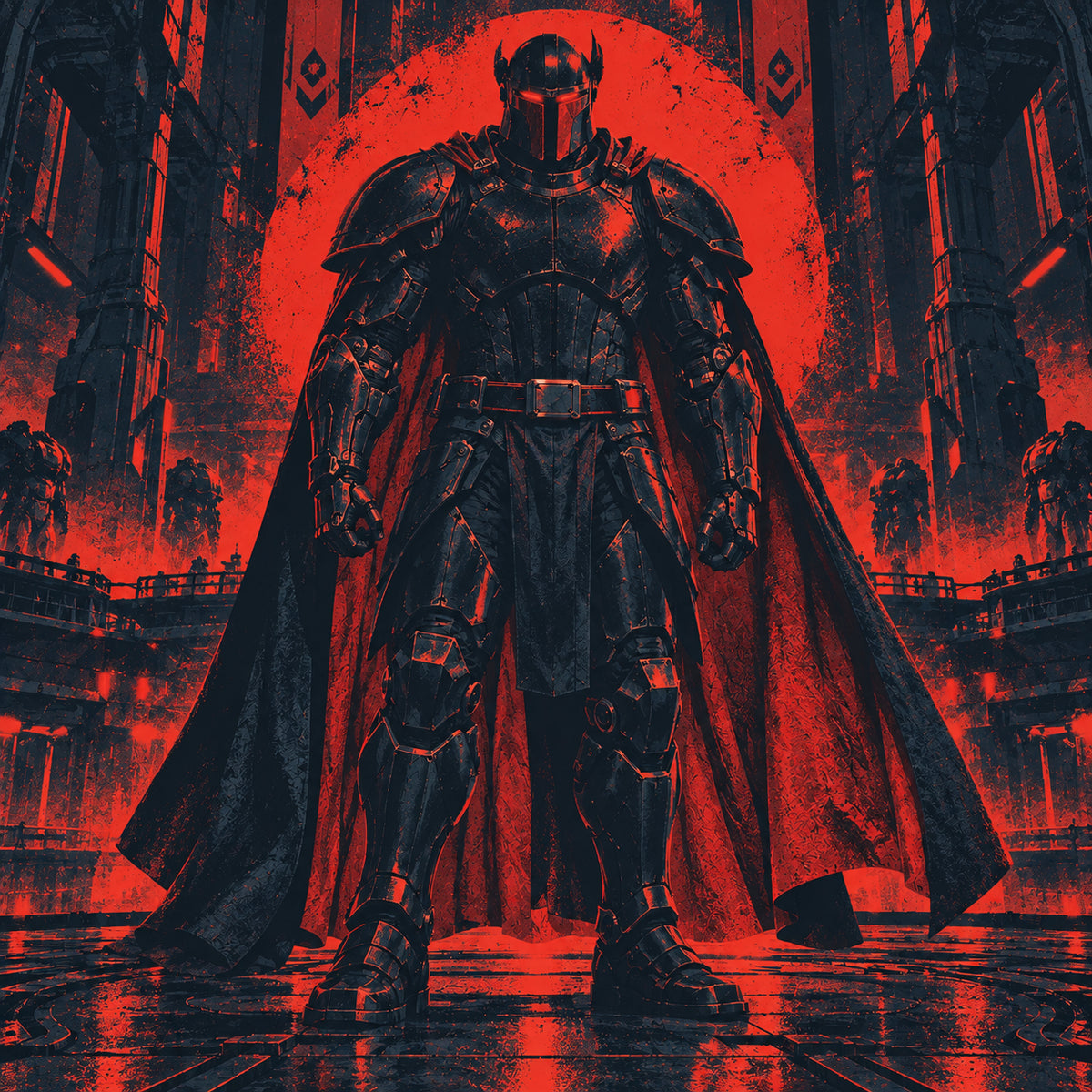
- Gideon's helmet deliberately resembles Mandalorian armor in silhouette, but its black finish, red details, horn-like projections, and Imperial styling transform that familiar shape into something much more threatening.
- The suit provides far greater physical protection and seems to enhance Gideon's strength, letting him fight Din Djarin at close range instead of relying only on blasters or troops.
- The armor reflects Gideon's obsession with taking useful elements from other cultures and technologies—including beskar, Mandalorian equipment, Dark Trooper engineering, and cloning—and placing them under Imperial control.
- Among Mandalorian armor villains, Gideon is unusual because he does not merely oppose Mandalorians. He attempts to appropriate the symbols, materials, and strategic advantages that define them.
Proof & Sources
The clearest evidence for Gideon's armor comes from The Mandalorian Season 3, especially the final confrontation on Mandalore, together with official Star Wars material describing Gideon, Dark Troopers, and Mandalorian history.
- Moff Gideon – Star Wars Databank
- The Mandalorian Chapter 23: The Spies – StarWars.com
- Mandalore – Star Wars Databank
- The Mandalorian – StarWars.com
Why would an Imperial warlord who helped destroy Mandalore eventually appear wearing armor that looks disturbingly similar to the culture he tried to conquer?
Gideon's armor is designed to look familiar and wrong at the same time.
The most important thing to understand about Moff Gideon's Mandalorian armor is that its resemblance to Mandalorian gear is intentional. Still, the suit isn't ordinary Mandalorian armor. Gideon isn't adopting the culture the way Din Djarin, Bo-Katan Kryze, or other Mandalorians do. He takes recognizable visual and technological elements from Mandalore and rebuilds them within an Imperial system designed around domination, surveillance, and military control.
That distinction explains why the suit feels so unsettling. The helmet carries the broad visual language of Mandalorian armor: a rigid armored shell, a narrow dark visor, strong cheek geometry, and a silhouette that immediately recalls warriors from Mandalore. Yet the details shift the design away from belonging and toward intimidation. Black metal dominates the suit, red accents break up the darkness, and horn-like structures change the helmet from something culturally familiar into something almost predatory.
Gideon therefore looks less like a Mandalorian who joined the Empire and more like an Imperial who has stripped Mandalorian identity down to the parts he finds useful. The armor protects, but it also makes a statement. Gideon wants Mandalore's material advantages without accepting the community, traditions, loyalties, or historical memory that give Mandalorian armor its deeper meaning.
Why the black armor appears only after Gideon loses control
Earlier versions of Gideon rely heavily on command. He has stormtroopers, Imperial officers, transports, bases, the Darksaber, and eventually Dark Troopers. His power comes from controlling systems and making other people fight for him. Even when he enters combat personally, an Imperial structure normally supports his authority.
Season 3 changes that situation. Gideon has lost the Darksaber, the surviving Mandalorians are reorganizing, and the Imperial remnant remains politically fragmented. His answer isn't to abandon his earlier methods, but to focus them on himself. Instead of sending only Dark Troopers or armored commandos, he eventually places himself inside an advanced armored suit.
That development fits his personality. Gideon constantly studies why other groups are dangerous, then tries to replicate those advantages under his own command. Mandalorians have beskar and a warrior tradition. Dark Troopers provide mechanical strength and protection. Force-sensitive subjects interest his cloning program. Gideon's final armor brings that same philosophy directly onto his body.
Read more: Moff Gideon's Mandalorian-Inspired Armor (& Darth Maul Horns) Explained
Is Moff Gideon actually wearing Mandalorian armor?
Calling it "Mandalorian armor" helps describe the visual inspiration, but it can also be misleading. Gideon isn't presented as joining Mandalorian society, earning armor through a clan, or adopting a Mandalorian identity. His suit belongs to his Imperial project.
That makes "Mandalorian-inspired Imperial armor" a more precise description. The helmet borrows the iconic silhouette, and the broader suit clearly reflects Gideon's access to beskar and Mandalorian resources, but its purpose is fundamentally different. Traditional Mandalorian armor carries family history, clan identity, inherited symbols, and cultural continuity. Gideon treats armor as technology that can be extracted, standardized, and weaponized.
The difference becomes even sharper on Mandalore itself. Gideon has built an Imperial base inside the planet that his regime helped devastate. He effectively occupies the physical remains of Mandalorian civilization while producing armored troops and advanced weapons from the resources that civilization once used.
His armor is therefore not cultural participation. It is appropriation backed by military power.
Beskar changes the suit's balance.
One of the most important materials in The Mandalorian is beskar. For Din Djarin, it carries cultural and personal significance. For the Empire, it is a strategic material with extraordinary defensive value.
Gideon understands the difference between those perspectives and consistently chooses the second one. He cares about what beskar lets him survive, build, and control.
By the Season 3 confrontation on Mandalore, Gideon's forces include armored troops whose equipment incorporates beskar-derived protection, and Gideon himself wears a suit capable of withstanding attacks that would be far more dangerous against ordinary Imperial armor. The visual logic is clear: the Empire has learned from the Mandalorians and is now trying to turn their defining material into an Imperial asset.
This makes Gideon especially dangerous because he is not ideologically attached to Imperial traditions for their own sake. If Mandalorian engineering works better, he will take it.
Why Gideon's armor resembles a Dark Trooper suit
The suit also connects directly to Gideon's Dark Trooper project. Dark Troopers previously represented an attempt to create highly durable mechanical soldiers that could overpower conventional opponents without relying on vulnerable human bodies.
Gideon's later armor takes that idea in a different direction. Rather than removing the human soldier entirely, the final system places Gideon himself inside a reinforced combat suit.
This development fits one of Gideon's most revealing ideas: previous Dark Trooper generations were powerful because they reduced human weakness, but his final concept reintroduces the human element with himself at the center. Gideon doesn't see himself as the system's weakness. He sees himself as the missing improvement.
That arrogance is essential to the Moff Gideon suit, properly explained. The armor is not only advanced technology. It represents Gideon's belief that the ultimate military platform combines superior materials, mechanized strength, Imperial engineering, and his own intelligence controlling everything from inside.
The suit gives Gideon a kind of mechanical strength.
When Gideon fights Din Djarin in the Season 3 finale, the battle immediately feels different from his earlier confrontations. Gideon is no longer simply a man wearing protective plating. The armor appears to assist his movements and increase the Force behind his attacks.
This is consistent with its Dark Trooper connection. The earlier droids were frightening partly because they could apply enormous mechanical power at close range. Gideon's suit appears to translate at least some of that advantage into wearable armor.
That matters because Din is an experienced Mandalorian fighter protected by beskar. Ordinary punches or simple armor would not make Gideon an equal threat in close combat. Enhanced strength lets him grapple, throw, and strike with enough Force that the fight becomes a contest between armored systems rather than a soldier and an unprotected officer.
Why Gideon no longer needs the Darksaber to look powerful
For much of Gideon's earlier story, the Darksaber provides instant visual authority. He doesn't culturally deserve it but still possesses it, making it an ideal symbol of his relationship with Mandalore. He holds something sacred to others and uses possession itself as leverage.
Once Din defeats him and the Darksaber eventually returns to Bo-Katan through the chain of events surrounding Mandalore, Gideon needs another visual language for power.
His armor fills that role.
Instead of carrying a Mandalorian symbol in his hand, Gideon places Mandalorian-derived technology across his entire body. The visual message shifts from "I possess your artifact" to something closer to "I have taken what makes you strong and rebuilt it around myself."
This makes the suit an appropriate progression from the Darksaber. Gideon's relationship with Mandalore has always been about control, not belonging.
The helmet deliberately echoes Mandalorian identity.
The helmet is the most important part of the design because the Mandalorian silhouette is already one of Star Wars' most recognizable visual forms.
Din Djarin's helmet communicates restraint and anonymity. Bo-Katan's helmet carries personal markings and an owl-like design tied to her identity. Gideon's version removes much of that individuality and replaces it with black Imperial severity.
The dark visor remains, but the surrounding structure feels more aggressive. The face is completely closed off, turning Gideon into an armored symbol rather than simply an Imperial officer.
The result is visually effective because audiences recognize the basic language before noticing the distortion. It is close enough to Mandalorian design to trigger familiarity and different enough to communicate hostility.
That visual discomfort is exactly what Gideon needs.
The horns change the helmet's meaning.
The horn-like projections on Gideon's helmet are among its most discussed features. They immediately make the armor look more aggressive and create an obvious visual link to earlier horned Mandalorian imagery tied to Darth Maul's period of control over Mandalore and his followers.
It is worth distinguishing visual interpretation from explicit canon confirmation. The series does not provide a technical explanation that Gideon chose the horns specifically as a tribute to Maul.
However, the visual association is difficult to ignore. Mandalore has a history of warriors wearing horned helmets during Maul's influence, and Gideon's design exists inside a story already deeply concerned with Mandalorian history.
The horns therefore function effectively whether they represent conscious in-universe imitation or visual storytelling for the audience. They make Gideon's armor feel like another corrupted version of Mandalorian identity.
Maul and Gideon represent different kinds of outsiders controlling Mandalore.
The visual echo becomes more interesting when Gideon is compared with Darth Maul. Neither character begins as part of Mandalorian culture, yet both establish control over Mandalorian people and institutions through the Force.
Maul takes control through combat, political manipulation, and defeating Pre Vizsla. Gideon represents Imperial conquest, intelligence operations, military destruction, and resource exploitation.
Their methods differ, but both show how outsiders can seize Mandalorian symbols.
That makes horned armor a particularly appropriate visual element for Gideon. Even without declaring a direct line of inspiration, the design places him within a recurring history of external powers attempting to dominate Mandalore and reshape its warrior identity for their own purposes.
The armor therefore carries historical echoes beyond its immediate military function.
Black and red transform Mandalorian design into Imperial design
Color does much of the remaining work. Traditional Mandalorian armor appears in an enormous variety of personal colors, reflecting clans, individuals, inherited pieces, and aesthetic preference.
Gideon's suit instead relies on an overwhelmingly black base with limited red detailing.
The combination feels militarized and authoritarian. Black suppresses the visual individuality many Mandalorians carry, while red creates sharp points of menace rather than broad decorative areas.
That palette also ties the armor to Gideon's broader Imperial environment. His base, troops, technology, and Praetorian Guards all exist inside a visual system dominated by black, red, and hard metallic surfaces.
Gideon therefore does not disappear into Mandalorian design. He absorbs Mandalorian geometry into an Imperial color language.
The armor hides the person more completely than his officer uniform.
Earlier, Gideon is visually recognizable as a man exercising institutional authority. His cape, uniform, rank, facial expressions, and controlled posture all shape his presence.
The final suit changes that relationship.
Once helmeted, Gideon becomes far less human in silhouette. The face disappears, the body becomes larger, and mechanical elements dominate the impression. He begins to resemble the weapon systems he once commanded.
That transition is thematically appropriate because Gideon increasingly treats himself as the endpoint of his own experiments. If Dark Troopers can improve soldiers, he will incorporate their technology. If beskar improves Mandalorians, he will take beskar. If cloning can replicate useful traits, he will try that too.
The armor physically turns Gideon into his own military project.
His suit is the opposite of Din Djarin's relationship with armor.
Din Djarin's armor develops through identity, community, and personal history. Beskar pieces are connected to the covert, the Armorer, the responsibilities of being a foundling, and eventually Din's relationship with Grogu.
Gideon sees the same material from the opposite direction.
To him, beskar is valuable because it resists weapons. Mandalorian design is valuable because it works. Cultural significance does not need to be preserved if the technological advantage can be extracted.
This contrast makes their final battle more meaningful than a simple fight between two armored men. Din wears armor because he belongs to a culture whose rules and values have shaped him. Gideon wears a derivative suit because he believes culture itself can be reduced to useful technology.
The confrontation is therefore partly a struggle over what Mandalorian armor actually means.
Bo-Katan creates an even sharper contrast.
Bo-Katan Kryze carries the historical and political dimensions of Mandalorian armor more directly than Din. Her armor connects her to family, earlier conflicts, the Nite Owls, Mandalore, and repeated attempts to reunite her people.
Gideon has also spent years shaping Mandalorian history, but from the position of an occupier and destroyer.
When both characters appear in armored combat during the finale, the contrast is striking. Bo-Katan represents continuity despite failure. Gideon represents appropriation despite victory.
He may wear superior technology and control a hidden base on Mandalore, but neither grants him Mandalorian legitimacy.
That difference helps explain why Gideon's armor can look so close to Mandalorian design while still feeling fundamentally alien.
Gideon treats culture as something that can be reverse-engineered.
This may be the most important idea behind the suit. Gideon approaches cultures and enemies like an intelligence officer studying systems.
He observes what makes them effective, separates those traits from their original meaning, and tries to reproduce them under his own control.
Mandalorians survive because of beskar, training, mobility, and strong warrior traditions. Gideon can copy the armor and material without accepting the community.
Dark Troopers are powerful because machines remove human physical limitations. Gideon can turn that engineering into a wearable system.
Force-sensitive beings possess abilities his troops cannot reproduce. Gideon's research turns toward cloning.
His philosophy is accumulation. Every useful advantage should eventually belong to him.
The Imperial commandos repeat Gideon's approach at a larger scale.
Gideon does not keep Mandalorian-inspired armor exclusively for himself. The troops defending his base also use equipment that visually combines Imperial and Mandalorian elements.
This makes the appropriation systematic rather than personal.
The Empire is effectively attempting to manufacture something Mandalorian-like without producing Mandalorians. Armor, jetpacks, and beskar-related protection become standardized military tools rather than expressions of individual warrior identity.
That idea is particularly threatening because Mandalorian culture has historically survived repeated attempts at destruction. Gideon's project goes one step further: he doesn't just want to defeat the culture. He wants to keep the useful parts after displacing the people themselves.
His own suit is simply the most advanced version of the same logic.
Read also: The Mandalorian and Grogu Home Release: Dates, Editions & Bonus Features
Why jetpacks matter to Gideon's army
Mandalorian mobility has always been one of the culture's defining battlefield advantages. Jetpacks allow warriors to change elevation, attack from unexpected directions, escape conventional ground formations, and fight effectively in complex environments.
Gideon's forces adopt that advantage as well.
This reinforces the idea that he is not copying appearance for symbolic reasons alone. He is studying the complete military system. If Mandalorians are difficult to defeat because they combine durable armor with exceptional mobility, then Imperial troops should have both.
The result is a force capable of fighting Mandalorians in their own style while remaining loyal to Gideon rather than to Mandalore.
That is far more dangerous than simply dressing stormtroopers in different helmets.
The suit reflects Gideon's obsession with improvement.
Gideon rarely treats any technology as final. He wants the next version.
The Dark Trooper program evolves. Cloning continues. Imperial bases become more secretive and specialized. Mandalorian resources are incorporated into new equipment.
His armor becomes the most direct expression of this mentality because the improvements no longer remain outside him.
He has spent years creating stronger troops, but the final stage is to make himself stronger.
This reveals a profound arrogance. Gideon does not believe the solution is replacing himself with a better leader or even creating a superior independent warrior. The final system must still place Gideon at its center.
Technology exists to increase his control, not to make him unnecessary.
Why the armor is more than a defensive upgrade
If the only purpose of the suit were survival, the symbolism would be unnecessarily elaborate. Gideon could use heavy armor without adopting a Mandalorian visor, horn-like features, black ceremonial styling, and a silhouette that deliberately invites comparison with the people he conquered.
The design therefore works on two levels. Practically, it protects and strengthens him.
Symbolically, it allows Gideon to embody his victory over Mandalore as he understands it. He occupies their planet, uses their material, copies their armor language, commands troops equipped with similar technology, and places himself at the top of that system.
The tragedy for Gideon is that these acts demonstrate possession without belonging.
Why the suit cannot make Gideon Mandalorian
Mandalorian identity has never been determined by genetics or equipment alone. The franchise repeatedly presents Mandalorian culture through clans, adoption, creed, loyalty, family, collective memory, and shared practice.
Din Djarin is one of the clearest examples because he becomes Mandalorian as a foundling rather than through biological ancestry.
That makes Gideon's approach fundamentally flawed.
He can take beskar. He can manufacture helmets. He can use jetpacks. He can build a base inside Mandalore itself.
None of those things automatically give him what the culture represents.
This is why the armor can be technologically successful while symbolically failing. Gideon can reproduce the shell but not the relationships that make the shell meaningful.
His armor also reflects his relationship with the Darksaber.
Gideon's earlier possession of the Darksaber follows the same pattern. He holds the object and understands its political usefulness, but the weapon in his hand doesn't make him a legitimate Mandalorian leader.
The Darksaber becomes leverage because other people care about what it means.
Gideon's armor does something similar. He recognizes that Mandalorian materials and symbols have power, but his understanding remains external. He knows how to exploit that meaning without sharing it.
This is one reason his progression from Darksaber owner to armored warlord feels coherent. In both cases, Gideon takes something deeply connected to Mandalorian history and tries to convert cultural significance into personal power.
Why Gideon's final form resembles a villainous Mandalorian
Among Mandalorian armor villains, Gideon is particularly effective because his design blurs recognition and rejection.
A viewer sees the T-shaped visor and armored silhouette and immediately thinks of Mandalore. Then the black-and-red palette, horns, mechanical strength, Imperial troops, and Gideon's history push the image in the opposite direction.
This creates a visual contradiction.
He looks as though he should belong to the culture, yet he represents almost everything the surviving Mandalorians are fighting against.
The design therefore makes Gideon a distorted mirror. He has their material without their loyalty, their armor language without their identity, and their battlefield advantages without their collective history.
The helmet makes Gideon less individual and more ideological.
Gideon has always been personally ambitious, but the helmet turns his final appearance into something larger than one Imperial officer.
Without the helmet, audiences see Giancarlo Esposito's facial control, calculation, and anger. With it, Gideon becomes a black armored symbol of Imperial appropriation.
That visual shift matters during the finale because the conflict has moved beyond Gideon's private rivalry with Din. Mandalorians are reclaiming their world while Gideon has embedded an Imperial military project beneath its surface.
His body now resembles the system he built.
The helmet lets the character stand almost as an embodiment of the occupation itself: Imperial, technologically advanced, built from stolen resources, and wearing the visual language of the people whose home it occupies.
The red details imply danger rather than heritage.
Red has many meanings across Star Wars, but Gideon's armor uses it primarily as an aggressive accent within a black mechanical design.
It does not function like the personal color schemes seen across many Mandalorian clans. Instead, the small red areas feel closer to warnings, energy, Imperial elite equipment, and visual hostility.
The effect is especially strong beside the red Praetorian Guards serving Gideon's larger plan. Both designs communicate an Imperial remnant moving toward something more specialized than ordinary stormtrooper forces.
Gideon's armor therefore reflects a broader visual shift from the old Empire's white-armored mass military toward darker, more secretive elite projects.
The suit reveals how Gideon understands power.
For Gideon, power is something that can be acquired by identifying the correct components.
Beskar provides protection. Dark Trooper technology provides strength. Mandalorian equipment provides mobility. Cloning offers replication. Force-sensitive biology represents another advantage that might theoretically be incorporated.
This is almost an engineer's approach to authoritarianism.
Gideon believes superiority can be assembled.
The problem is that Star Wars repeatedly suggests power cannot be understood only through components. Community, sacrifice, trust, belief, and personal choice can matter as much as weapons.
Gideon understands hardware extraordinarily well, and people much less.
His armor is therefore both evidence of his intelligence and evidence of its limits.
His final armor also responds to fear.
Gideon presents himself as controlled, but much of his behavior stems from fear of losing control.
Mandalorians survive when they were supposed to remain scattered. Grogu escapes his research. Din defeats him. Bo-Katan returns. Imperial politics move beyond his direct authority.
The armored suit allows Gideon to reduce some of that uncertainty.
He becomes harder to shoot, harder to overpower, and less dependent on ordinary troops. The armor is a technological answer to vulnerability.
Yet the more Gideon protects himself through technology, the more isolated he becomes inside his own system.
That isolation makes the armor as psychologically useful as it is physically useful.
The destruction of his cloning project exposes the limits of total control.
Gideon's Mandalore base contains more than armor. His cloning project reveals that he has been attempting to extend the same philosophy into biology.
The idea is consistent with everything else he does: identify useful traits, reproduce them, remove unpredictable weaknesses, and keep the final result under his authority.
Din and Grogu's destruction of those clones is therefore more than the loss of laboratory equipment. It destroys a major part of Gideon's attempt to manufacture a future in which all useful forms of power converge under his control.
His armor survives long enough for the final battle, but the larger project is already collapsing around him.
Why the final battle has to happen on Mandalore
The location gives every part of Gideon's armor additional meaning.
If the same suit appeared on an unrelated Imperial cruiser, it would still look impressive. On Mandalore, every design choice becomes political.
Gideon stands on the homeworld of the people whose armor language he copied. His base uses resources tied to the planet. His troops mimic Mandalorian battlefield advantages. The people he tried to scatter are returning above him.
The conflict becomes a struggle over who gets to define Mandalore's future.
Gideon's suit says technology and conquest should decide.
The Mandalorians answer through collective return.
Why Bo-Katan and Din fight Gideon together
The final confrontation is not framed as one destined hero defeating Gideon in a traditional duel. Din and Bo-Katan both engage him, and Grogu also influences the outcome.
That matters thematically because Gideon has built himself around individual control.
His suit concentrates different technologies into one person. His clones reproduce himself. His military structure depends on his command.
The Mandalorian side operates increasingly through cooperation.
Din is not trying to become ruler. Bo-Katan does not reclaim Mandalore alone. Different Mandalorian factions learn to act together despite years of division.
The battle therefore contrasts Gideon's centralized model of power with a community rebuilding itself collectively.
The destruction of the Darksaber changes the symbolism again.
During the final confrontation, Gideon crushes the Darksaber while Bo-Katan is holding it.
For a weapon that has carried enormous political importance, the moment is startling.
Yet its destruction also fits the larger development of Mandalorian identity. The people reclaiming Mandalore ultimately cannot depend forever on one artifact to decide legitimacy.
Gideon once benefited enormously from the weapon's symbolic power. Destroying it in the final battle does not destroy Mandalore.
The Mandalorians remain.
That contrast devastates Gideon's worldview. He understands symbols as tools of control, but the culture survives beyond the object.
His armor can imitate Mandalorian technology, and he can destroy a Mandalorian relic, yet neither action gives him ownership over the people themselves.
Why Gideon's armor does not save him
The suit is powerful. It protects Gideon, enhances him physically, and allows him to fight enemies who would have overwhelmed the Imperial officer seen in earlier seasons.
But the armor is not absolute.
The final destruction of the Imperial base creates a level of Force that personal armor cannot simply solve. More importantly, Gideon's defeat happens after the structure supporting his power has already been dismantled.
His troops are being defeated. His clones are destroyed. His base is compromised. The Mandalorians are returning.
The armor can protect one body, but it cannot preserve an entire system once that system collapses.
This makes the suit's failure thematically appropriate, not merely technical.
Moff Gideon's suit is the ultimate expression of his philosophy.
Everything Gideon values eventually appears inside or around the armor: Imperial engineering, Mandalorian material, Dark Trooper strength, symbolic intimidation, centralized control, and his belief that he personally belongs at the top of the hierarchy.
That makes the suit far more revealing than a typical costume upgrade.
It is Gideon's worldview made physical.
He sees cultures as technologies to dismantle and reuse. He sees soldiers as platforms to be improved. He sees biology as something to be replicated. He sees himself as the person qualified to combine all of those systems.
The armor is therefore both his greatest achievement and the clearest demonstration of why he misunderstands the people he is trying to dominate.
Why the armor is one of The Mandalorian's strongest villain designs
The suit works even before the audience analyzes every detail. A black armored figure wearing a distorted Mandalorian helmet immediately feels wrong.
Then the story gives that discomfort meaning.
Gideon helped devastate Mandalore, exploited its resources, possessed the Darksaber, built a secret Imperial facility beneath the planet, equipped his troops with Mandalorian-inspired technology, and ultimately placed himself inside the most advanced version of that system.
Every visual choice therefore connects back to his relationship with Mandalore.
The armor does not create a new character. It reveals the logical endpoint of the character Gideon has always been.
What Gideon's armor means for Mandalorian identity
The suit's deepest meaning comes from the fact that it fails to prove what Gideon wants it to prove. He can copy the shape, the material advantages, the mobility, and even the intimidating presence of Mandalorian warriors, but he cannot manufacture belonging.
👉 Explore more lightsabers here.
That failure separates Gideon from Din Djarin and Bo-Katan Kryze more clearly than any technical comparison. Din's identity develops through adoption, creed, loyalty, and responsibility. Bo-Katan's develops through family, failure, leadership, and renewed commitment to her people. Both relationships are imperfect and complicated, but they are relationships. Gideon reduces the same culture to equipment.
The final battle therefore becomes more than a contest over whose armor is stronger. Gideon has built the most technologically complete imitation he can produce, while the actual Mandalorians are rebuilding a society through cooperation. One side believes power can be assembled from stolen advantages. The other proves that a culture survives because people continue choosing to belong to it.
That is why Moff Gideon's Mandalorian armor is such an effective final design. It gives him greater power while exposing his central misunderstanding. He can take beskar, copy a helmet, build jet-equipped troops, study Dark Troopers, and turn Mandalore into a laboratory, but none of those achievements make him Mandalorian. The suit is a perfect shell around a man who understands almost everything about Mandalorian military strength, except why that strength keeps surviving.
FAQs
What armor does Moff Gideon wear in The Mandalorian Season 3?
Gideon wears an advanced black Imperial combat suit influenced by Mandalorian armor and connected to his Dark Trooper research.
Is Moff Gideon's armor actually Mandalorian armor?
It is better described as Mandalorian-inspired Imperial armor. Gideon adopts Mandalorian design and material advantages without becoming part of Mandalorian culture.
Is Moff Gideon's armor made from beskar?
His Season 3 forces and armor are associated with the Empire's use of beskar-based or beskar-alloy protection from Mandalore, giving Gideon much greater resistance than ordinary Imperial armor.
Why does Moff Gideon look like a Mandalorian?
Gideon has systematically studied and appropriated Mandalorian technology. His final suit uses their recognizable helmet language and battlefield advantages within an Imperial design.
Why does Moff Gideon's helmet have horns?
The horns make the helmet more aggressive and visually echo horned Mandalorian imagery associated with Maul's earlier influence over Mandalore. However, the series does not explicitly state that Gideon designed them as a direct tribute to Maul.
Is Moff Gideon a Mandalorian?
No. He is an Imperial officer and warlord who fought against and exploited Mandalore.
Is Gideon's armor a Dark Trooper suit?
It represents the culmination of his Dark Trooper development, combining a human wearer with advanced mechanical armor rather than relying entirely on an autonomous droid body.
Does Moff Gideon's suit make him stronger?
Yes. His final armored appearance shows substantial physical enhancement, letting him overpower and grapple with experienced armored fighters more effectively than an ordinary human could.
Why is Moff Gideon's armor black?
The black finish reinforces his Imperial, villainous identity while distinguishing his Mandalorian-inspired armor from the more personal color schemes of Mandalorian clans.
What do the red parts of Gideon's armor mean?
The red elements primarily function as aggressive visual accents within the black Imperial design. The series does not provide a detailed cultural explanation for every red component.
Join the Nsabers Community
Bring the Force into your world with Nsabers.
✨ Follow Nsabers across the galaxy:
💬 We'd love to hear from you!
Share your thoughts, leave a comment below, or tag us on social media.
May the Force be with you!

Commenta
Nota che i commenti devono essere approvati prima di essere pubblicati.
Questo sito è protetto da hCaptcha e applica le Norme sulla privacy e i Termini di servizio di hCaptcha.