

Quick Answers
- The term Star Wars Genesis Lightsaber is not a standard, widely established canon name for a specific lightsaber in the major Star Wars films, television series, or commonly referenced official Databank material.
- “Genesis Lightsaber” is more likely a fan-created name, custom saber name, product label, concept design, game-related term, or community shorthand than an official lightsaber category.
- A unique-looking lightsaber doesn't automatically become canon just because it resembles Star Wars design language or appears in fan art, custom builds, mods, or merchandise.
- Canon lightsabers are normally connected to a confirmed character, story, historical event, or officially published source, such as the Darksaber, Kylo Ren's crossguard saber, or the distinctive weapons used by characters like Ahsoka Tano.
- If you encounter a Genesis Lightsaber Star Wars listing or image, the most important question is where the name originated, because the source determines whether it belongs to canon, Legends, licensed material, or fan-created culture.
- Star Wars' unique lightsabers are canonically real. Still, you shouldn't treat "Genesis Lightsaber" as an official canon weapon without a reliable Lucasfilm or Star Wars source linking the name to the universe.
Proof & Sources
Official Star Wars material clearly documents recognized lightsabers, their owners, and unusual weapon designs. These references help distinguish officially established weapons from names that circulate mainly through fan communities, custom saber culture, or third-party terminology.
What does "Genesis Lightsaber" actually mean in Star Wars?
If the phrase "Genesis Lightsaber" sounds like the name of an ancient Jedi relic or forgotten Sith weapon, why is it so difficult to connect that name to a clearly documented canon story? The simplest answer is that the phrase does not function like familiar official lightsaber names such as the Darksaber or Kylo Ren's crossguard weapon. In the major canon material most fans use as reference points, "Genesis Lightsaber" isn't established as a standard named artifact with a confirmed owner, origin, or history.
That does not mean the phrase is meaningless. Star Wars fandom has always created names for custom hilts, concept designs, role-playing weapons, game builds, cosplay props, and collector pieces. A dramatic word like "Genesis" naturally suits a powerful or ancient lightsaber, especially when paired with an unusual hilt or visual identity. The problem begins when a community or product name is mistaken for official Star Wars lore.
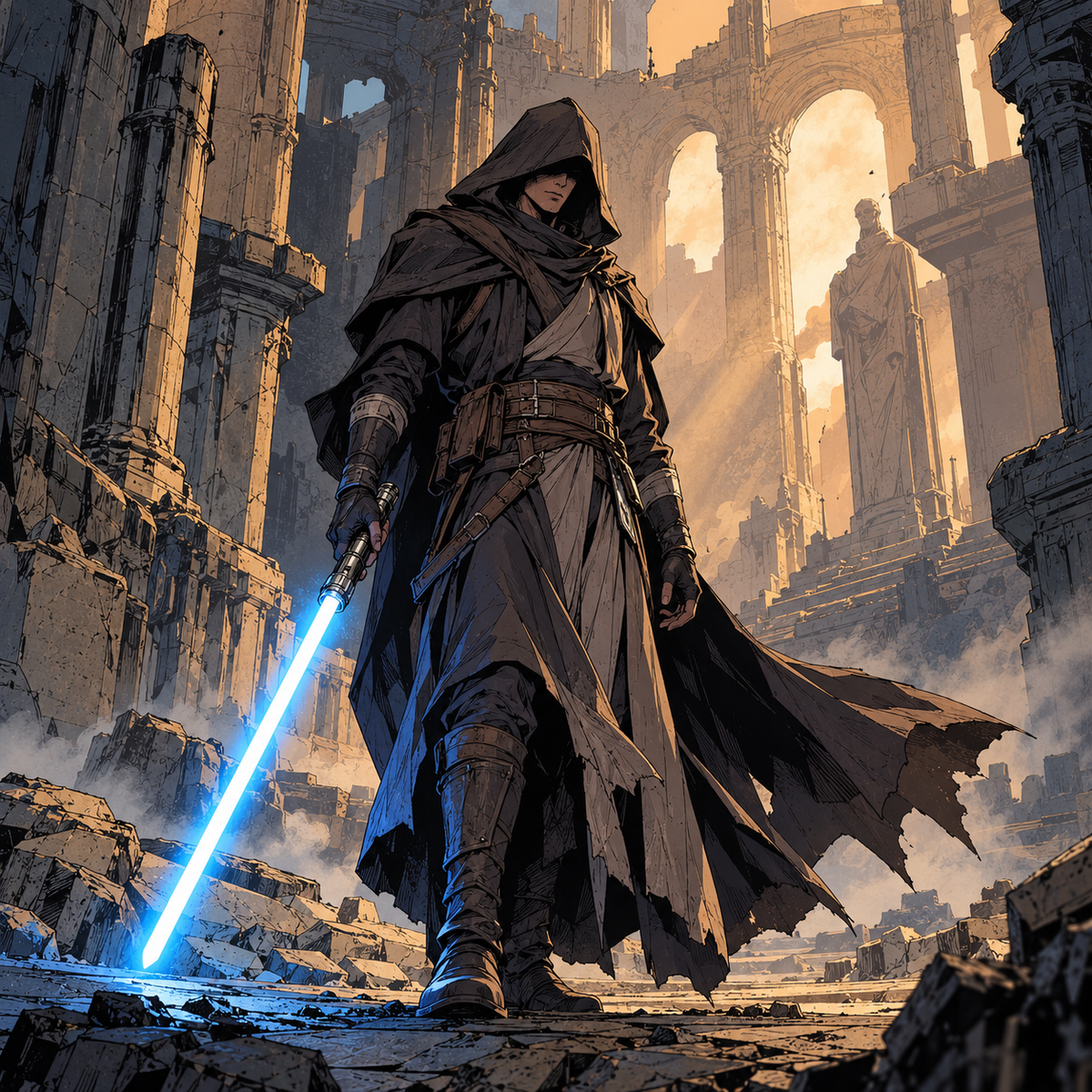
The safest approach is to separate the name from the design. Someone may show you a highly detailed lightsaber called the Genesis and describe it using Star Wars language, but that doesn't automatically establish the weapon as canon. The hilt may still borrow recognizable elements from Jedi, Sith, High Republic, Old Republic, or other Star Wars aesthetics without being an official character's personal weapon.
Why the name sounds believable even when its canon status is uncertain
"Genesis" is a particularly convincing fictional name because it suggests beginnings, creation, or the birth of something important. Those ideas fit naturally into Star Wars, a franchise filled with ancient orders, lost temples, forgotten Force traditions, and weapons carrying generations of history. Without context, a fan might assume it refers to the first lightsaber, an early Jedi prototype, or an ancient Force artifact.
That assumption makes sense because some officially recognized Star Wars weapons do have special names. The Darksaber is not simply "a black lightsaber." It is a unique historical weapon associated with Tarre Vizsla and later Mandalorian leadership. The name carries narrative weight because official stories explain its origin, who possessed it, and why it mattered.
A phrase such as Star Wars Genesis Lightsaber can imitate that naming pattern very effectively. It sounds like a proper noun, which encourages people to treat it as lore before checking whether an official story actually supports the interpretation. This is one of the most common ways confusion develops around unusual Star Wars weapon names online.
Read more: All 20 Lightsaber Types In Star Wars Canon Explained
How official lightsabers usually become recognizable canon objects
A canon lightsaber usually becomes important because someone owns it or it plays a role in a story. Luke Skywalker's green lightsaber matters because Luke constructed and carried it during a crucial stage of his development as a Jedi. Anakin Skywalker's blue weapon became historically significant because it passed through multiple owners and generations. Ahsoka Tano's white blades are memorable because their color and construction connect directly to her history with the Force.
The Darksaber follows the same principle more explicitly. Its unusual appearance attracts attention, but the weapon becomes truly important because stories establish Tarre Vizsla, House Vizsla, Mandalore, Pre Vizsla, Maul, Sabine Wren, Bo-Katan Kryze, and Din Djarin around it. The design and narrative reinforce each other until the weapon becomes an artifact rather than merely a distinctive prop.
That is the standard a supposed Genesis Lightsaber must meet before fans can confidently describe it as canon. A traceable source should connect the name to an official story, character, era, or publication. Without that foundation, the phrase remains a label rather than established lore.
A dramatic design is not enough to establish canon.
Modern custom saber culture has become extraordinarily sophisticated. Builders can create metal hilts with weathering, crystal chambers, exposed electronics, unusual emitter shapes, ancient-looking engravings, leather wrapping, crossguards, curved grips, or complex internal lighting. Some designs look so convincing they could easily appear in a film or television series.
Visual authenticity, however, is not the same thing as narrative authenticity. A custom weapon may perfectly reproduce Star Wars design language while having no official connection to Lucasfilm storytelling. This distinction matters most when images circulate without captions or when products are reposted across social platforms after the original creator's context disappears.
The same problem occurs with concept art and fan art. An artist may intentionally imagine an ancient Jedi weapon and call it Genesis because the name fits the concept. Once the image leaves the original account, later viewers may see only the design and name. From there, a fan creation can gradually begin to look like a forgotten canon artifact even though nothing about its original purpose changed.
The difference between canon, Legends, and fan-created material
Star Wars terminology becomes easier to understand when these categories remain separate. Current canon broadly refers to the continuity Lucasfilm recognizes across officially designated films, series, books, comics, games, and related material produced within the modern continuity framework. Legends refers to much of the older Expanded Universe continuity, reorganized under the Legends label in 2014.
Fan-created material exists outside both categories. It can draw on canon or Legends, combine elements from both, or invent something entirely new. Custom lightsaber communities often do exactly this, creating weapons that look like they belong to Jedi, Sith, Mandalorians, or entirely original Force traditions.
A weapon becomes Legends not because it is not canon. This is a particularly important distinction. If the Genesis Lightsaber Star Wars name cannot be found in canon, the next conclusion should not automatically be that it must come from Legends. It may simply be a modern fan or product designation with no official narrative continuity at all.
Was there a first lightsaber in Star Wars history?
Star Wars has explored the development of Jedi weapons across different continuities, but calling the "Genesis Lightsaber" the first lightsaber as shorthand lacks evidence. The technological history of lightsabers is far more complicated than a single weapon suddenly appearing fully formed.
Legends material developed early lightsaber concepts in considerable detail, including older technologies and transitional weapons. Modern canon has approached ancient Jedi history differently and continues to expand earlier periods through new stories. As a result, fans should be cautious when blending older lore explanations with modern canon and attaching them to a contemporary custom saber name.
In ordinary English, the word genesis describes the beginning of something, but that doesn't make "Genesis Lightsaber" the official name for the beginning of lightsaber technology. Naming an object and proving its place in fictional history are two separate steps.
Why the Darksaber is a useful comparison
The Darksaber shows what a genuinely named, unique Star Wars lightsaber looks like in lore. Its black blade is visually extraordinary, but fans do not need to infer its importance from appearance alone. Official stories provide a creator, historical context, cultural significance, later owners, and major events connected to the weapon.
Its origin with Tarre Vizsla links the weapon to both Jedi and Mandalorian history. Later possession transforms the Darksaber into a symbol of political authority. When Maul wins it, Sabine Wren trains with it, or Din Djarin carries it, those events add new chapters to an already documented artifact.
A supposed Genesis Lightsaber would need comparable narrative evidence before it should be discussed in the same category. A unique color, dramatic emitter, or unusual hilt can make a weapon interesting, but canon status comes from officially established storytelling rather than visual distinctiveness.
Kylo Ren's lightsaber shows another form of uniqueness.
Kylo Ren's crossguard lightsaber is another useful comparison because its unusual appearance has an explicit narrative and functional identity. The unstable red blade and side vents immediately distinguish it from conventional weapons. The design also reflects the weapon's unstable energy and reinforces Kylo's aggressive visual identity.
Fans therefore do not need to invent a separate origin simply because the saber looks unusual. The weapon appears directly in canon stories, belongs to a clearly identified character, and is recognized through official Star Wars material.
This is how Star Wars' unique lightsabers become legitimate lore objects. Story evidence supports their distinctiveness. A custom design can look equally impressive, but without that story connection it remains custom. The difference is not quality. It is continuity.
Ahsoka's white lightsabers prove that color alone can carry history.
Ahsoka Tano's white blades show how visual design becomes meaningful when lore explains it. Their color is not merely an aesthetic alternative to blue or green. The crystals behind the blades connect to Ahsoka's history after leaving the Jedi Order and to the purification of crystals previously affected by the dark side.
Because official storytelling supports that process, fans can discuss the white blades as part of Ahsoka's canon identity. The unusual color becomes a narrative clue rather than a random visual choice.
If someone presents a Genesis Lightsaber with a rare blade color, the same standard should apply. The color can suggest an interpretation, but it does not prove one. A gold, cyan, black, unstable, split, or multicolored blade may look meaningful, but the story must establish what it actually means.
The same rule applies to unusual hilt shapes.
Star Wars contains many unconventional hilts. Count Dooku's curved weapon reflects a very different approach from the more cylindrical designs associated with many Jedi. Maul's double-bladed saberstaff supports a radically different combat geometry. Kylo Ren's crossguard changes both silhouette and fighting possibilities, while the Inquisitors' weapons use rotating double-bladed mechanisms that create another distinct category.
These examples make almost any creative custom hilt feel plausible inside the universe. A designer can combine familiar elements and produce something that immediately "reads" as Star Wars.
But plausibility should never be confused with canon confirmation. If a Genesis Lightsaber has an unusual crossguard, split emitter, crystal chamber, or ancient finish, those details may tell us what the designer wanted the weapon to evoke. They cannot independently tell us that a Jedi or Sith in official continuity ever carried it.
Why product names often create canon confusion
Commercial naming makes the issue even more complicated. Custom saber companies and independent sellers often give products evocative names instead of generic model numbers. A hilt might be called Genesis, Sentinel, Revan-inspired, Fallen, Guardian, Eclipse, or another dramatic term designed to communicate mood and style.
Those names help distinguish products, but they can sound like official Star Wars artifacts. Someone who finds a listing through an image search may see the words "Genesis Lightsaber" without realizing the name came from a seller rather than a Star Wars story.
Once the context is lost, search behavior can reinforce the misunderstanding. People start asking who used the Genesis Lightsaber or when it appeared in Star Wars, and those questions make the weapon sound increasingly official.
The safest rule is simple: a product name shows how a product is marketed, not canon.
Read also: Top 10 Most Unique Lightsaber Hilts in Star Wars Canon and Legends
Could Genesis refer to a game, mod, or fan project?
That is another realistic possibility. Star Wars games have long encouraged customization, and PC communities often create mods that introduce new lightsaber hilts, colors, outfits, and character models. A weapon called Genesis could easily originate in that context without appearing in the base game's official narrative.
Role-playing communities produce similar terminology. Players may create an original Jedi or Sith, develop a backstory, and give that character's weapon a personal name. Within the community, the Genesis Lightsaber may have extensive lore, multiple owners, and even a detailed creation story. None of that makes the project less creative or valuable.
It simply exists at a different level of continuity.
When investigating an unfamiliar lightsaber name, identifying the original platform is therefore extremely useful. Interpret a title attached to a game mod, fan fiction, custom saber build, or role-playing wiki through that source rather than automatically moving it into official Star Wars history.
Why Star Wars fans are especially vulnerable to believable false lore
The Star Wars universe is enormous. Even dedicated fans cannot know every weapon, minor character, comic issue, novel, game, sourcebook, and historical reference. That creates ideal conditions for believable misinformation.
If someone mentions an obscure "Genesis Lightsaber," many readers may hesitate to challenge it because the weapon could theoretically come from a comic they never read or a game they never played. The larger the fictional universe becomes, the easier it is for unofficial names to hide among genuinely obscure canon and Legends details.
A missing origin becomes a forgotten Jedi temple. An unusual blade color becomes evidence of a secret Force order. Repetition then spreads those invented details.
The responsible approach is the opposite. When the source does not establish a detail, uncertainty should remain visible rather than being replaced with a story that merely sounds like Star Wars.
How to verify whether an unusual lightsaber is canon
First, look for the weapon in an official Star Wars source rather than searching only the name. Character Databank pages, official episode guides, film material, official Star Wars articles, and clearly identified canon publications are much stronger evidence than social posts or product descriptions.
The second step is to identify where the image or term first appeared. If the source is a custom saber builder, fan artist, mod page, or role-playing community, that context usually answers the canon question immediately.
The third step is to distinguish appearance from naming. A canon character may inspire a custom hilt that receives a new commercial name. That does not mean the commercial name belongs to the fictional character.
Finally, check whether the supposed history appears consistently in recognized sources. If every explanation traces back to unsourced reposts rather than a story or official article, treat the claim cautiously.
Why a fan-made Genesis Lightsaber can still matter
Canon status is not the only way a lightsaber can be interesting. Custom saber culture exists partly because the Star Wars idea of constructing a personal weapon invites fans to imagine what their own Jedi or Sith lightsaber would look like.
A fan-designed Genesis Lightsaber can therefore have real creative value even without official continuity. Its name may express a personal beginning, a new character, a first custom build, or the origin of an imagined Force tradition. In some ways, that kind of naming fits the spirit of lightsaber mythology extremely well.
The important thing is transparency. Calling a weapon fan-made does not diminish its design. It simply tells the audience which kind of story they are looking at.
Confusion only becomes a problem when unofficial material is presented as documented canon history.
Unique lightsabers have always encouraged personal interpretation.
One reason unusual saber designs attract so much attention is that the lightsaber itself has always been personal. Jedi traditionally build their own weapons, and hilts vary by era, owner, training, available materials, and personal preference.
That concept naturally encourages fans to imagine new designs. If every Jedi carried the same anonymous weapon, custom saber culture would have much less room to grow. Instead, Star Wars repeatedly shows that a hilt can communicate personality.
Maul's saberstaff communicates a different fighting identity from Dooku's curved hilt. Ahsoka's paired white weapons tell a different story from Luke's green saber. The Darksaber carries cultural history beyond its function as a weapon.
A custom Genesis design follows that same visual language, even when it remains outside canon.
Can a fan-created lightsaber ever become canon later?
In principle, Star Wars has a long history of ideas evolving, being reinterpreted, or appearing in new forms across different media. However, fans should not assume popularity alone automatically makes an unofficial design canon.
Canonization would require official use or recognition within Lucasfilm storytelling. If a future film, series, book, comic, or game introduced a weapon explicitly called the Genesis Lightsaber, the situation would change. From that moment, the new official material would define what the name means within continuity.
The important point is that canon status depends on the official appearance itself, not on earlier speculation.
Until such evidence exists, a fan name remains a fan name even if thousands of people recognize it.
Is "Genesis" perhaps being confused with another famous lightsaber?
Always consider that possibility when a search term seems familiar but cannot be confidently matched to an official object. Star Wars contains so many famous weapons that names can blur together, especially when fans remember a visual design but not the original terminology.
The Darksaber, crossguard lightsabers, double-bladed sabers, Inquisitor sabers, white lightsabers, yellow Temple Guard weapons, and numerous character-specific hilts can all become simplified in memory. A custom design may then receive a dramatic name that feels more official than the actual source terminology.
Names may also overlap with those used by games, collectibles, fan projects, or saber manufacturers. This is another reason the question "Where did you first see the name?" is often more useful than immediately asking which Jedi owned it.
What makes a genuinely unique canon lightsaber?
A truly unique canon lightsaber usually combines several layers of identity. Its physical design differs from ordinary weapons, its owner or history is documented, and its unusual features relate to the story.
The Darksaber carries Mandalorian political meaning. Kylo Ren's saber reflects instability through its blade and crossguard vents. Ahsoka's white blades connect to purified crystals and her post-Jedi identity. Maul's saberstaff reinforces his distinctive combat style. Count Dooku's curved hilt reflects his specialized dueling approach.
These weapons are memorable because design and narrative reinforce each other.
A Genesis Lightsaber could theoretically achieve the same status if an official story established it. Without that story, its design may still be distinctive, but the narrative half of the equation remains absent.
Is the Genesis Lightsaber canon right now?
Based on established Star Wars terminology and official lightsaber material that can be reliably identified, Genesis Lightsaber is not a standard, recognized canon weapon name like the Darksaber or specific character lightsabers.
That wording is important. It does not claim that no fan project, custom saber, licensed product, game modification, or unofficial concept has ever used the name. In fact, such a natural phrase could easily appear in more than one independent context.
This means the name shouldn't be presented as a documented canon artifact without a source proving that connection.
If you encounter a specific Genesis Lightsaber image or listing, the source of that exact version matters. Different creators could use the same name for completely different designs.
Why source checking matters more than the design itself
Star Wars fans are used to unusual weapons, which makes visual judgment unreliable. A saber can look completely unlike anything seen before and still be canon if an official story introduces it. Conversely, a weapon can look perfectly authentic and remain entirely fan-made.
The deciding factor is therefore provenance.
Where did the term originate? Was it attached to a Lucasfilm story, an official Star Wars game, a licensed reference book, a custom saber shop, a fan artist, or a social media post? Each source gives the same words a different meaning.
Once you answer that question, most confusion disappears.
This is especially useful for obscure names because it prevents the discussion from turning into speculation about imaginary owners, eras, or crystal histories.
Genesis may be more valuable as an idea than as a canon claim.
The name Genesis is appealing precisely because it feels open-ended. It could represent a Jedi's first self-built saber, the beginning of a new Force tradition, a reconstructed weapon after personal transformation, or simply a collector's first serious custom hilt.
Those meanings do not require Lucasfilm approval to be creatively interesting.
In fact, custom saber culture often works best when it uses Star Wars design language to create something personal rather than pretending every original hilt belongs to an existing character. A fan can build a weapon that feels authentic to the galaxy while still acknowledging that the story belongs to them.
The Genesis name fits that approach naturally because it suggests a beginning rather than demanding a connection to a specific established hero.
What the Genesis question teaches us about Star Wars lore
The confusion around names like Genesis reveals something important about modern Star Wars fandom: official canon, Legends, licensed products, games, fan creations, replicas, mods, and social media aesthetics now exist side by side.
A single image can move between all those spaces without carrying its original context.
That makes source awareness increasingly important. Knowing Star Wars today is not only about remembering characters and events. It also means understanding where a claim comes from.
A weapon can be beautifully designed, widely shared, and strongly associated with Star Wars culture without belonging to the official narrative continuity. 👉[Explore more lightsabers here](https://nsabers.com/collections/master-saber).
Where the Genesis Lightsaber fits among Star Wars unique lightsabers
The broader category of Star Wars unique lightsabers is very real. Star Wars has shown black blades, crossguards, saberstaffs, rotating Inquisitor weapons, curved hilts, paired short blades, unusual colors, and numerous character-specific constructions.
That creative variety is one reason a name like Genesis feels completely plausible. The fictional technology is flexible enough that a convincing designer can invent a new hilt without obviously violating the universe's visual rules.
But uniqueness and canon are separate qualities. A weapon can be unique without being canon, and a canon weapon can be visually simple while carrying enormous narrative importance.
The Genesis Lightsaber is best approached through that distinction rather than by trying to force it into a canon timeline without evidence.
So what is the Star Wars Genesis Lightsaber?
The most accurate answer is that the Star Wars Genesis Lightsaber appears to function more as an unofficial, context-dependent name than as a universally recognized canon artifact. Without a specific official source, don't describe it as an ancient Jedi weapon, the first lightsaber, a Sith relic, or the personal saber of a known character.
If you encounter a specific version, investigate that version's origin. It may be a custom saber, fan concept, collectible name, game-related creation, or another community design. You can then explain its history accurately based on that source.
That answer may be less dramatic than inventing a forgotten Jedi legend, but it is much more useful. Star Wars already contains enough genuinely strange and fascinating weapons without needing to turn every believable custom name into official lore.
FAQs
What is the Star Wars Genesis Lightsaber?
The term does not appear to be a standard official canon name for a specific lightsaber. It is more likely a custom, fan-created, product, or context-specific designation unless you provide a specific official source.
Is the Genesis Lightsaber canon?
No widely established canon weapon is known specifically as the Genesis Lightsaber in the major official Star Wars material commonly used to identify named lightsabers.
Is the Genesis Lightsaber the first lightsaber ever created?
There is no reliable canon basis for treating a weapon called the Genesis Lightsaber as the first lightsaber.
Who owns the Genesis Lightsaber in Star Wars?
No established canon owner can be confidently assigned to a weapon under that exact name without a specific official source.
Is the Genesis Lightsaber a Jedi weapon?
Not as a confirmed universal canon fact. A custom or fan-created version may be designed as a Jedi weapon, but that depends on the source of the specific design.
Is the Genesis Lightsaber a Sith weapon?
Canon provides no evidence that the name refers to a specific Sith artifact. A red-bladed custom design may use Sith aesthetics without becoming canon.
Could the Genesis Lightsaber come from Legends?
A non-canon name should not automatically be classified as Legends. Legends is an established continuity, while fan-created and commercial saber names exist outside both canon and Legends.
Why does the name Genesis Lightsaber sound official?
"Genesis" suggests origins, ancient history, and creation, themes that fit naturally into Star Wars lore. That makes the name believable even without an official story.
How can I tell whether a lightsaber is canon?
Check whether the weapon appears in an official Star Wars film, series, book, comic, game, Databank entry, or other recognized Lucasfilm source.
Can a custom lightsaber look canon without actually being canon?
Yes. Modern custom sabers can closely reproduce Star Wars design language while remaining completely original creations.
What are some genuinely unique canon lightsabers?
The Darksaber, Kylo Ren's crossguard lightsaber, Maul's double-bladed saberstaff, Ahsoka Tano's white-bladed weapons, and Count Dooku's curved-hilt lightsaber are examples of distinctive weapons connected to established stories.
Is the Darksaber the same thing as a Genesis Lightsaber?
No. The Darksaber is a specific canon artifact with a documented history, while Genesis Lightsaber is not a standard official name for the Darksaber.
Could Lucasfilm introduce a Genesis Lightsaber in the future?
A future official story could theoretically use almost any new weapon name, but it would only become canon once official material actually introduced it.
Why do fan-made lightsaber names become confused with canon?
Custom designs are often visually convincing, and images can lose their original context when reposted. Dramatic product or fan names may then be mistaken for official lore terminology.
Join the Nsabers Community
Bring the Force into your world with Nsabers.
✨ Follow Nsabers across the galaxy:
💬 We'd love to hear from you!
Share your thoughts, leave a comment below, or tag us on social media.
May the Force be with you!

Commenta
Questo sito è protetto da hCaptcha e applica le Norme sulla privacy e i Termini di servizio di hCaptcha.